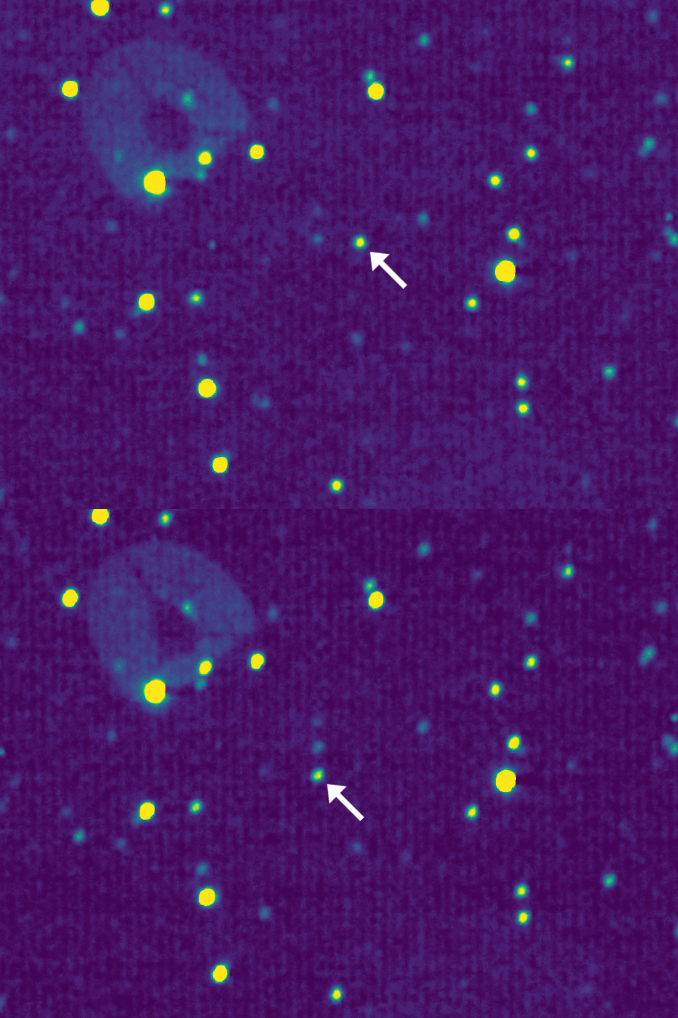
Above, the first two of the 20 observations that New Horizons made of 1994 JR1 in April 2016. The Kuiper Belt object is the bright moving dot indicated by the arrow. The dots that do not move are background stars. The moving feature in the top left is an internal camera reflection (a kind of selfie) caused by illumination by a very bright star just outside of LORRI’s field of view; it shows the three arms that hold up LORRI’s secondary mirror. Image credit: NASA/Johns Hopkins University Applied Physics Laboratory/Southwest Research Institute.Warming up for a possible extended mission as it speeds through deep space, NASA’s New Horizons spacecraft has now twice observed 1994 JR1, a 90-mile (145-kilometre) wide Kuiper Belt object (KBO) orbiting more than 3 billion miles (5 billion kilometres) from the Sun. Science team members have used these observations to reveal new facts about this distant remnant of the early solar system.
Taken with the spacecraft’s Long Range Reconnaissance Imager (LORRI) on 7-8 April from a distance of about 69 million miles (111 million kilometres), the images shatter New Horizons’ own record for the closest-ever views of this KBO in November 2015, when New Horizons detected JR1 from 170 million miles (280 million kilometres) away.
Simon Porter, a New Horizons science team member from Southwest Research Institute (SwRI) in Boulder, Colorado, said the observations contain several valuable findings. “Combining the November 2015 and April 2016 observations allows us to pinpoint the location of JR1 to within 1,000 kilometres (about 600 miles), far better than any small KBO,” he said, adding that the more accurate orbit also allows the science team to dispel a theory, suggested several years ago, that JR1 is a quasi-satellite of Pluto.New Horizons scientists used light curve data the variations in the brightness of light reflected from the object’s surface to determine 1994 JR1’s rotation period of 5.4 hours. Image credit: NASA/Johns Hopkins University Applied Physics Laboratory/Southwest Research Institute.From the closer vantage point of the April 2016 observations, the team also determined the object’s rotation period, observing the changes in light reflected from its surface to determine that a JR1 “day” is 5.4 hours. “That’s relatively fast for a KBO,” said science team member John Spencer, also from SwRI. “This is all part of the excitement of exploring new places and seeing things never seen before.”
Spencer added that these observations are great practice for possible close-up looks at about 20 more ancient Kuiper Belt objects that may come in the next few years, should NASA approve an extended mission. New Horizons flew through the Pluto system on 14 July 2015, making the first close-up observations of Pluto and its family of five moons. The spacecraft is on course for an ultra-close flyby of another Kuiper Belt object, 2014 MU69, on 1 January 2019.
New research from North Carolina State University finds that major volcanic activity on the innermost planet most likely ended about 3.5 billion years ago — in stark contrast to the volcanic ages found for Venus, Mars and Earth. These findings add insight into the geological evolution of Mercury and what happens when rocky planets cool and contract.
NASA’s New Horizons mission has found evidence of exotic ices flowing across Pluto’s surface, at the left edge of its bright heart-shaped area. New close-up images from the spacecraft’s Long-Range Reconnaissance Imager (LORRI) reveal signs of recent geologic activity, something scientists hoped to find but didn’t expect.
Ground controllers have pressurised the Juno spacecraft’s propulsion system in preparation for a 5 July rocket firing by the probe’s UK-made rocket engine that will steer the spinning, solar-powered robot into orbit around Jupiter.