
The Moon may preserve a record of the raw ingredients that helped life begin on Earth. New analysis of lunar samples returned by China’s Chang’e missions has revealed a diverse suite of organic compounds embedded within the soil. They offer a rare glimpse of the early Solar System’s chemistry that has long since been erased from our planet.
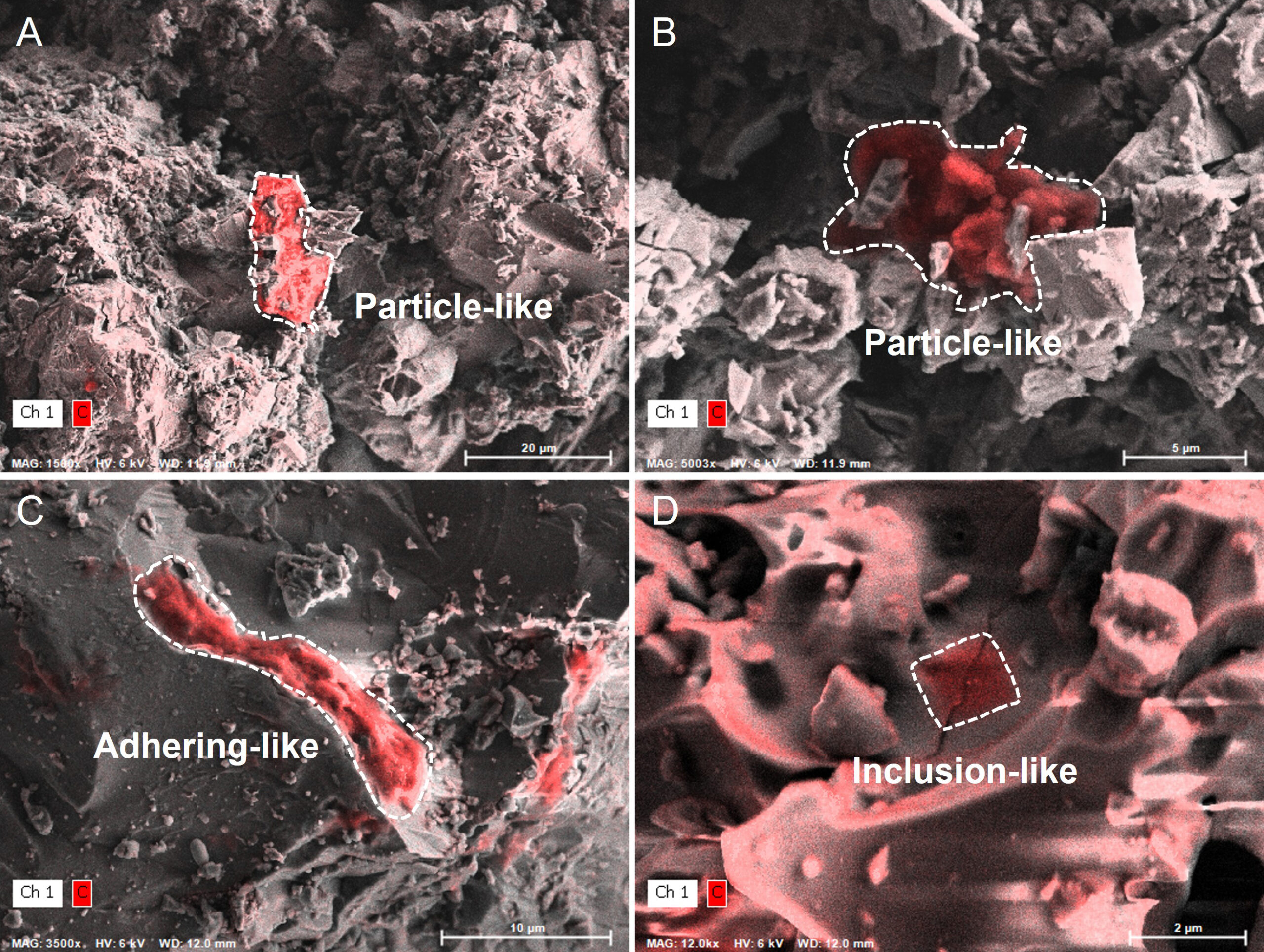
The findings come from material collected by Chang’e-5 and Chang’e-6, which brought back samples from the Moon’s surface in 2020 and 2024 respectively. Using high-resolution analytical techniques, researchers identified nitrogen-bearing organic matter occurring in several distinct forms, including particle-like fragments, thin coatings and inclusions within mineral grains.
These features are typically only a few micrometres across or smaller. Chemically, the material is dominated by carbon, nitrogen and oxygen, and is largely amorphous rather than crystalline. In some cases, the team identified amide functional groups, which represent a more complex level of chemical organisation. These findings indicate that the lunar organic matter has undergone some chemical reworking, rather than remaining in a primitive, unaltered state.
To be clear, these compounds are not signs of life. Instead, they are simple carbon-based molecules, widely regarded as the chemical precursors to biology. Yet, their presence on the Moon is significant because it provides a relatively unaltered record of the processes that distributed and transformed organic material in the early Solar System.
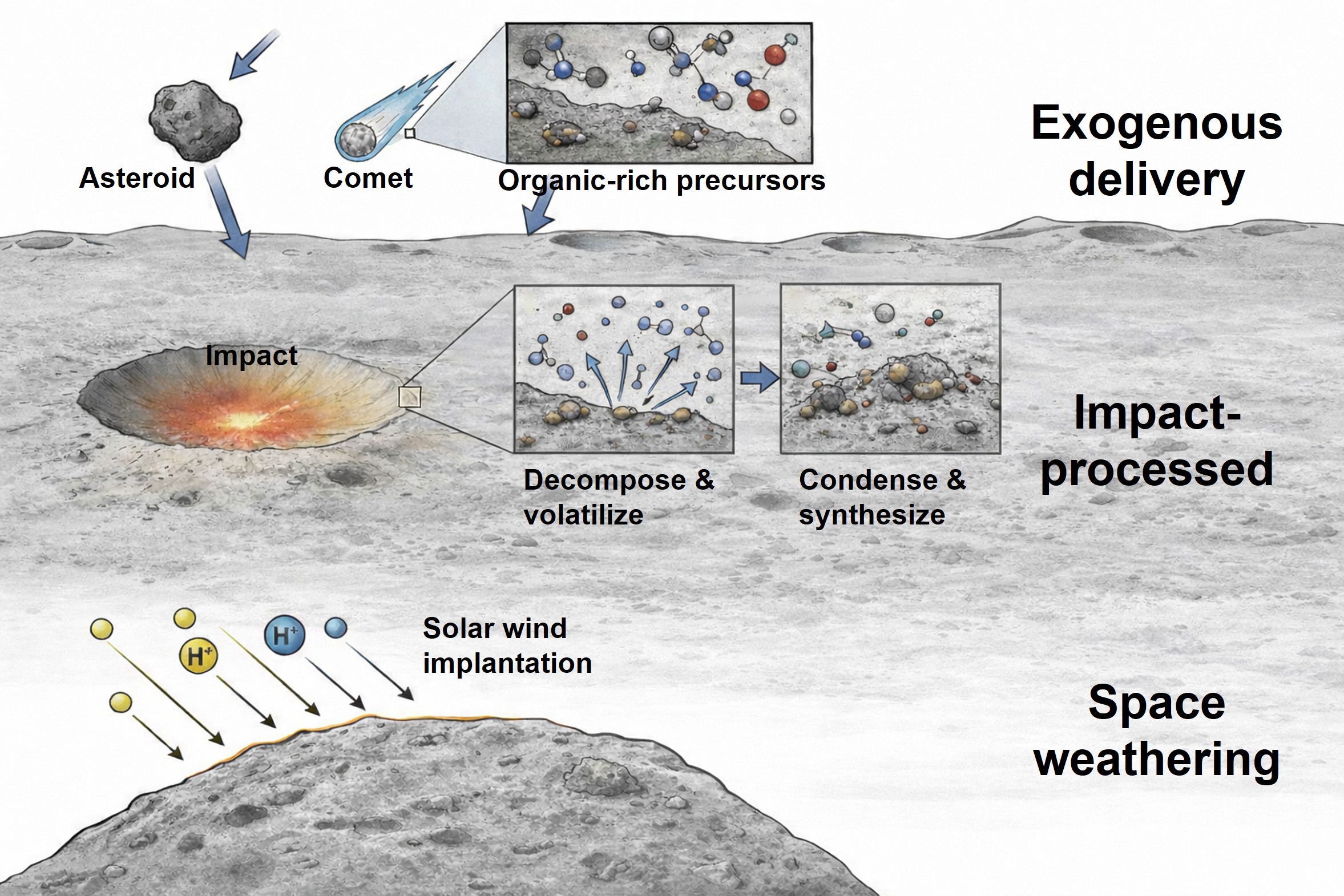
According to the research team, the most likely origin of the material is from colliding asteroids and comets that were rich in organic compounds. The cratered face of the Moon tells us that these have bombarded the lunar surface for billions of years. As they struck, they delivered carbon-bearing material that became mixed into the regolith. Unlike Earth, where geological activity and weathering recycle and erase ancient records, the Moon has remained largely unchanged, even though the researchers found that some alteration had clearly taken place.
Isotopic measurements reinforce this picture of active processing on the lunar surface. Isotopes are atoms of the same element that have different masses because they contain different numbers of neutrons. Researchers found that the hydrogen, carbon and nitrogen isotopic ratios are systematically lighter than those typically found in carbonaceous meteorites, implying that the material has been modified after its initial delivery.
The researchers interpret this as evidence for repeated cycles of impact-driven heating, evaporation and re-condensation. In this scenario, incoming asteroids and comets deliver organic material, which is then partially broken down and vaporised by other impacts before re-condensing onto surface mineral grains, forming new nitrogen- and oxygen-bearing compounds.
Further evidence of surface processing comes from signatures of ‘solar wind implantation’, the embedding of charged particles from the Sun into the outer layers of lunar grains. It is identified here for the first time in lunar organics. Variations in hydrogen isotopes and hydrogen-to-carbon ratios near grain surfaces point to prolonged irradiation by charged particles from the Sun. This ‘fingerprint’ of solar wind interaction also helps rule out terrestrial contamination as the source of the material.
The team describe the Moon as acting like a ‘time capsule’, storing evidence of how organic matter has evolved under space conditions. By studying these materials in detail, scientists can begin to reconstruct how the building blocks of life were delivered across the Solar System and how they were altered before ever reaching a planet like Earth.
The results also highlight the growing importance of sample-return missions. Laboratory analysis of pristine material allows researchers to probe chemical structures at a level of detail that remote observations or even in-situ experimentation cannot match. With further samples expected from future lunar missions, the Moon is likely to play an increasingly important role in understanding the chemical pathways that may ultimately have led to life on Earth.
The study was led by a research team from the Institute of Geology and Geophysics of the Chinese Academy of Sciences (IGGCAS), in collaboration with researchers from institutions including the University of New Mexico and Changsha University of Science and Technology. Their findings were published in Science Advances on 8 April and can be read in full here.