
23 September 2026
Astronomy Now
  • Home
  • The Magazine
    • About
    • Current Issue
    • Subscribe
    • Renew Subscription
  • AstroFest 2026
  • News
  • Observing
    • UK Sky Chart
    • Almanac
    • Scope Calc
    • DSLR Calc
  • Reviews
    • Equipment
    • Book Reviews
  • Spaceflight Now
  • Shop
  • Contact Us
    • Subscriptions
    • Your Views
    • Ask Astronomy Now
    • Editorial
    • Advertising
    • AstroListings
Latest News
  • [ 8 September 2026 ] 3I/ATLAS was born in the deep freeze News
  • [ 30 August 2026 ] Roman Space Telescope launches on mission to survey the Universe News
  • [ 24 August 2026 ] JWST’s ‘impossible’ early galaxies may be even more massive than we thought News
  • [ 7 August 2026 ] How to observe the 12 August 2026 solar eclipse Eclipse
  • [ 5 August 2026 ] Falcon 9 lunar impact: More than a new crater News
  • Facebook
  • Twitter
  • LinkedIn

Archive

Observing

Double the fun as magnitude-3.6 star λ Geminorum is hidden by the Moon

8 December 2014 Ade Ashford

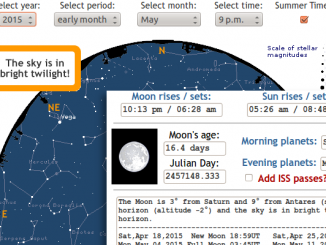
The last lunar occultation of a conspicuous naked-eye star for UK observers in 2014 occurs around 6 am on Tuesday, 9th December. Set your alarm and prepare your telescope for the disappearance and reapparance of λ Geminorum.

Observing

New interactive website tools for observers

8 December 2014 Ade Ashford

Astronomy Now Online brings you a powerful interactive global Almanac and UK-based all-sky star maps — the first of a new suite of tools to help plan your observing sessions and travel.

News

Dawn snaps its best-yet image of dwarf planet Ceres

7 December 2014 Astronomy Now

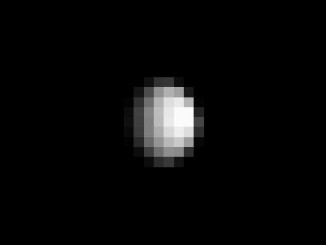
Launched in 2007, NASA’s Dawn spacecraft is preparing for its encounter with dwarf planet Ceres, imaging the body from a distance of 740,000 miles as a final calibration of the probe’s science camera. Dawn will be captured into Ceres’ orbit in March 2015.

News

Finding infant Earths and potential life just got easier

7 December 2014 Astronomy Now

Two researchers at New York’s Cornell University have found that on infant worlds, the habitable zone is located further away from their young parent star than previously thought. Life could arise on planets in the early phase of the coolest stars.

News

Pulsar with black hole could hold the ‘holy grail’ of gravity

6 December 2014 Astronomy Now

The intermittent light emitted by a pulsar allows scientists to verify Einstein’s theory of relativity, especially when paired up with another neutron star that interferes with its gravity. According to researchers from Spain and India, this theory could be analysed much more effectively if a pulsar with a black hole were found.
News

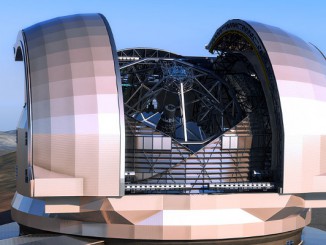
Green light for construction of European Extremely Large Telescope

5 December 2014 Astronomy Now

The European Southern Observatory’s Council has authorised spending of around one billion euros for the construction of the 39-metre aperture European Extremely Large Telescope (E-ELT) on Cerro Armazones in the Chilean Atacama Desert.

Picture This

Craters Hipparchus and Albategnius

4 December 2014 Mark Armstrong

First or last Quarter Moon is the best time to see some of the magnificent crater chains near the centre of the Earth-turned lunar hemisphere. Marnix Praet from Belgium provides this high-resolution view of the Hipparchus and Albategnius region.

News

Researchers suggest Martian meteorite contains organic carbon of biological origin

4 December 2014 Astronomy Now

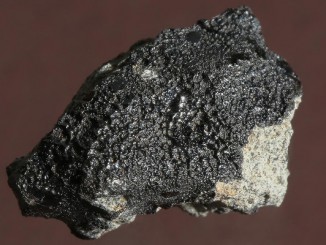
An analysis of a Martian meteorite named Tissint, seen to fall in the Moroccan desert on 18th July 2011, revealed small fissures filled with organic carbon that is possibly biological in origin, according to an international research team.

News

Hayabusa 2 launches on audacious asteroid adventure

3 December 2014 Stephen Clark

A Japanese H-2A launcher blasted off from an idyllic island spaceport Tuesday, dispatching a daring six-year expedition to bring a piece of an asteroid back to Earth.

Observing

Jupiter’s moon dance and shadow play to delight observers

3 December 2014 Ade Ashford

The orbits of Jupiter’s large Galilean moons Io, Europa, Ganymede and Callisto are presently almost edge-on to our line of sight, causing the moons to regularly eclipse and occult each other. Multiple shadow transits are also on view!

Posts pagination

« 1 … 344 345 346 … 357 »

Latest Issue

Astronomy Now Newsletter

Get the wonders of the Universe delivered to your inbox. Sign up before 24 September for a 10% discount code for your Stargazer's Guide 2027!
* indicates required
Which elements of Astronomy interest you?

News Headlines

  • 3I/ATLAS was born in the deep freeze
    8 September 2026
  • Roman Space Telescope launches on mission to survey the Universe
    30 August 2026
  • JWST’s ‘impossible’ early galaxies may be even more massive than we thought
    24 August 2026
  • How to observe the 12 August 2026 solar eclipse
    7 August 2026
  • Falcon 9 lunar impact: More than a new crater
    5 August 2026

© 2026 Nebula Press Ltd

Astronomy Now