Observing

Get ready for prime-time Jupiter and its multi-moon events in June 2019

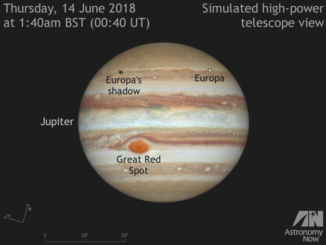
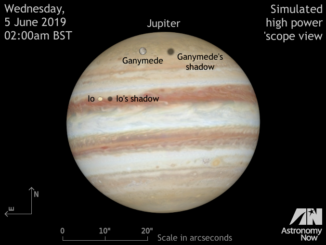
Jupiter, the solar system’s largest planet, reaches opposition on 10 June in the constellation of Ophiuchus (the Serpent Bearer) and is visible low in the southern sky of the UK through the night. Observers with small to medium aperture telescopes can see a number of shadow transits of Jupiter’s Galilean moons and view the planet’s Great Red Spot throughout June.
Observing

July’s Jupiter events visible from the UK

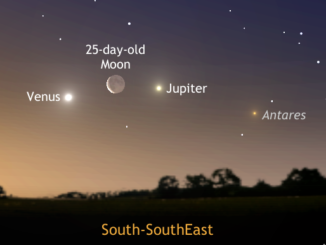
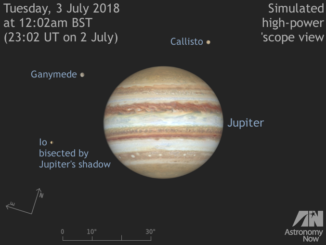
The start of July finds magnitude -2.3 Jupiter almost two months past opposition and highest in the southern sky around 30 minutes before sunset for observers in the British Isles. The solar system’s largest planet may be past its best, but there still plenty of Jovian events visible from the UK.

Observing

June’s Jupiter events visible from the UK

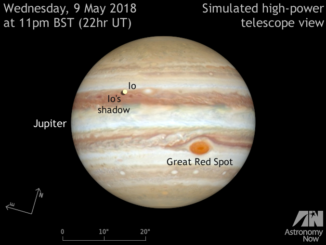
Jupiter has passed opposition, but the solar system’s largest planet is still putting on a magnificent show in the southern sky at dusk. Backyard telescopes readily reveal its Great Red Spot storm feature and four main moons constantly playing tag. Here’s our full guide to Jovian events visible from the UK in June.

Observing

See the young crescent Moon meet Venus at dusk on 18 April

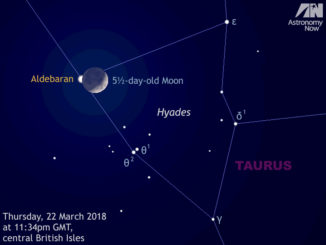
Observers in Western Europe should try to locate Venus low in the western sky an hour after sunset. The 3-day-old slim crescent Moon acts as a convenient guide, located some 12½ degrees (or half the span of an outstretched hand at arm’s length) to the upper left of the brightest planet on 18 April. Prominent star Aldebaran lies in the same low-power binocular field of view as the Moon too.

Observing

See the Moon hide double star Porrima then get close to Jupiter on 3—4 June

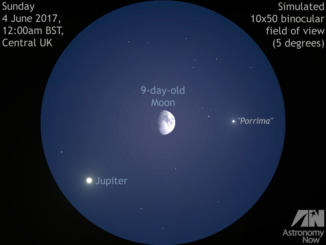
Jupiter now lies highest in the UK sky at sunset, but the Solar System’s largest planet and its four bright Galilean moons still provide plenty of observable events during June, as we reveal. If you’re uncertain which evening ‘star’ is Jupiter, the Moon conveniently passes by on the night of 3—4 June, a time when European skywatchers can also see the Moon occult (hide) bright double star Porrima.