News

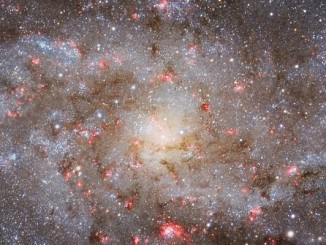
This glorious image of the core of Local Group galaxy Messier 33 (NGC 598) in the constellation Triangulum was captured from Almere, Flevoland, Netherlands by astrophotographer Michael van Doorn — winning image of the Galaxies category in the Insight Astronomy Photographer of the Year competition 2015.

A Lawrence Livermore National Laboratory team has combined theoretical and computational physics techniques using the Laboratory’s 2-petaflop Vulcan supercomputer to devise a new model of dark matter. They found that dark matter is “stealthy” today, but would have been easy to detect in the extremely high-temperature plasma conditions that pervaded the early universe.


The central supermassive black hole of a recently discovered galaxy called SAGE0536AGN is far larger than should be possible, according to current theories of galactic evolution. The galaxy was found by accident with NASA’s Spitzer space telescope and is thought to be at least 9 billion years old. Time will tell whether SAGE0536AGN really is an oddball, or simply the first in a new class of galaxies.

This new image of the rose-coloured star forming region Messier 17 was captured by the Wide Field Imager on the MPG/ESO 2.2-metre telescope at ESO’s La Silla Observatory in Chile. It is one of the sharpest images showing the entire nebula and not only reveals its full size, but also retains fine detail throughout the cosmic landscape of gas clouds, dust and newborn stars.

Astronomers using the Atacama Large Millimeter/submillimetre Array (ALMA) have discovered two spectacular rings of molecules encircling the young, Sun-like star IM Lup. The rings are made up of one of the most common heavy ions in space — DCO+ (deuterium, carbon, oxygen). This chemistry reveals new insights into the conditions of the planet-forming disc surrounding this star.

This image was captured from Sunset Peak, Lantau Island, Hong Kong by astrophotographer Chap Him Wong. Above the peak covered with gold and silver grass, the tantalising sky reveals star trails and the Milky Way beyond — winning image of the People & Space category in the Insight Astronomy Photographer of the Year competition 2015.
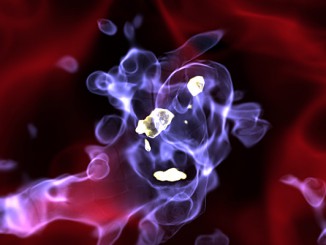
The brightest galaxies in the universe, known as submillimetre galaxies (SMGs), aren’t visible to the naked eye. But look through an infrared telescope, and they light up the sky. They are probably 12 or 13 billion years old, and what makes them so luminous is that they form stars very quickly — 1000 times faster than our Milky Way. Now researchers have the first viable model of the origins of SMGs.
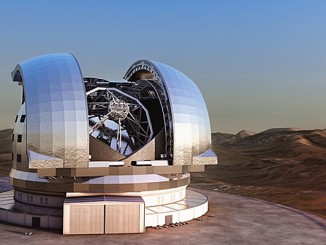
UK researchers have just signed an agreement to lead one of the first instruments for what will become the World’s largest visible and infrared telescope, the European Extremely Large Telescope (E-ELT). The spectrograph, called HARMONI, will provide the European Southern Observatory’s telescope with a sensitivity that is up to hundreds of times better than any current telescope of its kind.
© 2026 Nebula Press Ltd