
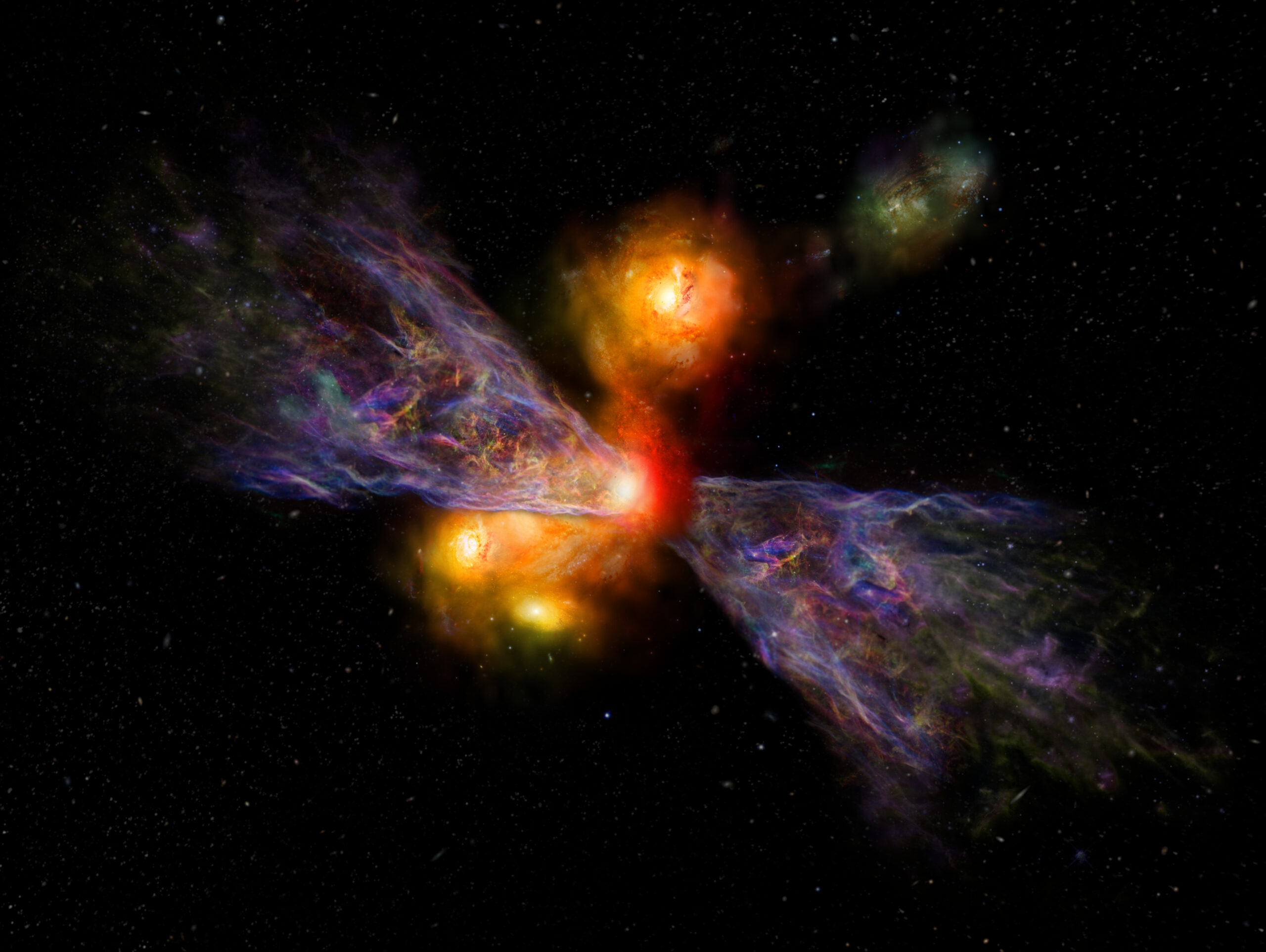
Astronomers have caught a young galaxy system apparently blowing away the gas it needs to keep making stars, offering a natural explanation for one of the surprises thrown up by the NASA/ESA/CSA James Webb Space Telescope: the large number of ‘dead’ galaxies in the early Universe.
The system, known as CRISTAL-02, is seen as it was just 1.1 billion years after the Big Bang. It is not a calm, settled galaxy, but a collection of star-forming clumps caught in the final stages of a cosmic collision. That collision appears to have funnelled gas into dense regions, triggering a furious burst of star formation. Now, the same process may be helping to shut the galaxy down for good.
The discovery, made using JWST and the Atacama Large Millimeter/submillimeter Array (ALMA), reveals a huge plume of cold gas extending around 7,000 light-years from CRISTAL-02. The gas is moving away from the galaxy in a powerful wind, driven not by an obvious active black hole but by the energy released when short-lived massive stars explode as supernovae.
“Dense regions of the universe are like very active cities,” says lead author Dr Rebecca Davies, of Swinburne University of Technology in Australia. “Galaxies collide and undergo frenzied bursts of star-formation. But when the biggest stars burn out, they explode as supernovae, launching powerful winds that blast away the very gas galaxies need to keep forming stars.”
The result is a possible ‘galaxy-killing wind’. Galaxies are often described as dead, or quiescent, when they have stopped forming significant numbers of new stars. Their existing stars may continue to shine for billions of years, but the galaxy’s growth has effectively ended because the cold gas reservoir from which new stars form has been removed, heated or used up.
JWST has already found unexpectedly large numbers of massive dead galaxies in the early Universe, when the cosmos was only one or two billion years old. This has posed a problem for galaxy evolution models, because such galaxies must have grown rapidly and then shut down almost immediately. Some proposed explanations have invoked more exotic early-Universe physics. For example, one idea is that dark energy, the mysterious force associated with the accelerating expansion of the Universe today, may have been stronger or behaved differently in the young cosmos, allowing galaxies to grow and die faster than expected.
The new study points to a simpler possibility: violent galaxy mergers may have triggered intense starbursts that then powered winds strong enough to sweep away the galaxies’ own fuel.
CRISTAL-02 is forming stars at a rate of around 260 solar masses per year, roughly three times faster than expected for a galaxy of similar mass at the same epoch. However, the outflow is removing gas at about 520 solar masses per year, twice the star-formation rate. If that continues, and if fresh cold gas is not drawn in from the galaxy’s surroundings, CRISTAL-02 could exhaust or eject its molecular gas reservoir on a timescale of tens of millions of years.
“The galaxy has a powerful wind that is ejecting material twice as fast as the galaxy forms stars,” says Davies. “If this rapid blowout continues, the galaxy could be dead in less than 50 million years.”
The evidence comes from combining two different views of the gas. ALMA detected the cold material, while JWST’s Near Infrared Spectrograph observed warmer ionised gas. Together, these observations reveal a wind made of gas in different physical states. Both appear to be moving out from the galaxy in a roughly two-coned shape, like material being blasted above and below a galactic disc, similar to winds seen in nearby galaxies undergoing intense bursts of star formation.
The researchers estimate that the outflow contains about 1.5 billion solar masses of cold gas. The projected outflow velocity is around 640 kilometres per second, comparable to the galaxy’s estimated escape velocity, meaning that some of the material may leave the system altogether rather than falling back later.
The team finds no evidence that a currently active supermassive black hole is powering the wind. However, the researchers note that they cannot entirely rule out an earlier burst of black-hole activity that has since faded.
If CRISTAL-02 is typical, the mechanism could be widespread. The study notes that almost half of massive galaxies at this epoch are undergoing major mergers. Such collisions can drive gas inward, ignite intense star formation and then launch powerful winds that suppress or even halt further star formation.
“Almost half of early massive galaxies are interacting with other nearby galaxies, suggesting this isn’t a quirk but a widespread cosmic phenomenon,” says Davies. “CRISTAL-02 offers a natural solution to the mystery of why these massive galaxies live fast and die young.”
Read more: Multiphase images of a powerful supernova-driven wind in the early Universe