News



A composite image from the Hubble Space Telescope shows a dramatic range of color in galaxy NGC 3344, a weakly barred spiral half the size of the Milky Way some 20 million light years away in the constellation Leo Minor. Hot young stars, seen in blue, populate the spiral arms along with glowing red clouds of gas and dust that provide the raw materials for new suns.


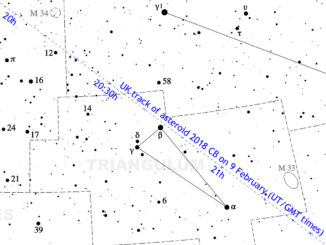
As darkness falls over Western Europe on the evening of 9 February, near-Earth asteroid 2018 CB lies almost overhead as seen from the UK. We show you how and when to find this 30-metre-wide space rock as it speeds through the constellations of Perseus and Triangulum, passing just one-fifth of the Moon’s distance away at 22:27 UT (10:27pm GMT).
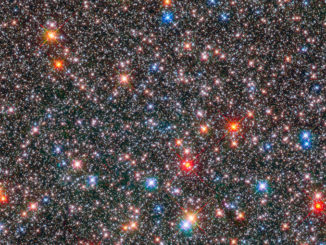
The Hubble Space Telescope captures a deep view of stars in the Milky Way’s central bulge, helping astronomers understand a dynamic environment where stars rich in heavier elements orbit the core faster than older stars that are deficient in such elements. The image is part of two on-going surveys to learn more about the galaxy’s structure and evolution.
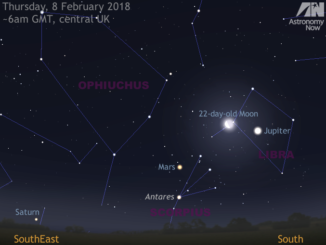
Set your alarm for 6am GMT if you wish to see three naked-eye planets in the UK dawn sky this week. Find a location that offers an unobstructed view of the horizon from southeast to south and let the waning Moon be your guide to locating Jupiter, Mars and Saturn on successive mornings from 7 to 11 February.
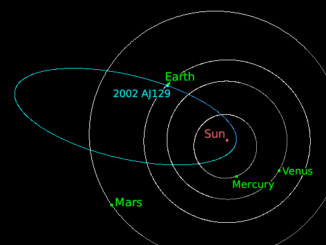
Possibly a kilometre or more in size, Apollo asteroid 2002 AJ129 passes just 10.9 lunar distances from Earth at 21:30 UT (9:30pm GMT) on 4 February — its closest approach for 114 years. For a few nights around this date the magnitude +12.6 body is well placed for observers as it gallops through the constellations of Virgo and Leo into Cancer at a rate of up to 40 degrees/day. We show you where and when to look for it.
© 2026 Nebula Press Ltd