
News

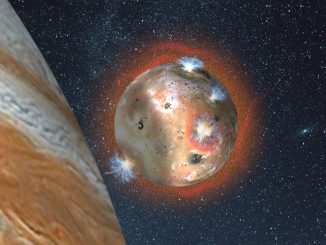
A team of scientists has documented atmospheric changes on Io, Jupiter’s volcanically active satellite, as the giant planet casts its shadow over the moon during daily eclipses. Io’s thin atmosphere collapses as the sulfur dioxide gas emitted from volcanoes freezes when shaded by Jupiter. The atmosphere reforms when Io moves out of eclipse and the ice sublimates.
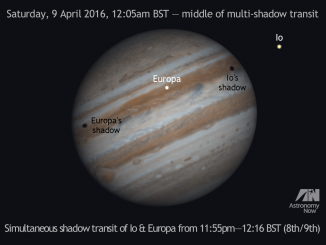
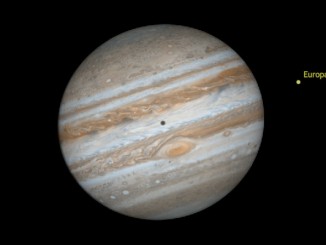
The impact of a small comet or asteroid on Jupiter observed by European amateur astronomers on 17 March has heightened interest in the solar system’s largest planet. While such an event is uncommon, Jupiter and its family of four bright Galilean moons provide a wealth of other interesting phenomena to view with small telescopes during April.

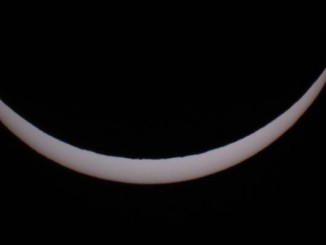
Although thick cloud in parts of Indonesia spoiled the view for some along the path of totality, tens of millions more were greeted to spectacular views of the 9 March total solar eclipse. NASA, in partnership with the Exploratorium Science Center, hosted live coverage of the event from the coral island of Woleai in the Pacific Ocean.
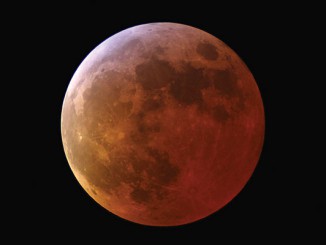
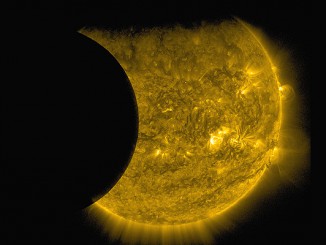
The alignment of Sun, Moon and Earth resulted in a partial solar eclipse on 13 September, visible only from the southern tip of Africa and Antarctica. But as NASA’s Solar Dynamics Observatory, or SDO, kept up its constant watch on the Sun, its view of the eclipse was photobombed by the Earth — the first time that an Earth eclipse and a lunar transit have coincided.
© 2019 Pole Star Publications Limited