News

Kepler-223 star system has four mini-Neptunes in synchronised orbits

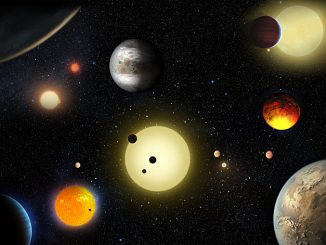
A four-planet system orbiting the star Kepler-223 in the constellation Cygnus is actually a rarity: Its planets, all miniature Neptunes nestled close to the star, are orbiting in a unique resonance that has been locked in for billions of years. For every three orbits of the outermost planet, the second orbits four times, the third six times and the innermost eight times.

News

2007 OR10: the largest unnamed world in the solar system

By combining data from two space observatories, astronomers have revealed something surprising: a 955-mile-wide dwarf planet named 2007 OR10 is significantly larger than previously thought. Although its 547-year-long elliptical orbit brings it nearly as close to the Sun as Neptune, 2007 OR10 is currently twice as far from the Sun as Pluto.

News

Natural causes, not aliens, explain mystery star’s behaviour

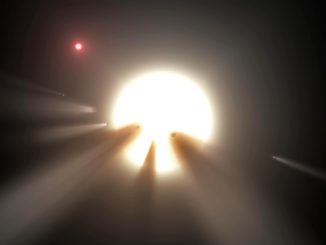
Media interest went viral last October when a group of astronomers from Pennsylvania State University cited that the “bizarre light curve” of KIC 8462852, popularly known as Tabby’s star, was “consistent with” a swarm of alien-constructed megastructures. Now, the results of a new study make it far less likely that KIC 8462852 is the home of industrious extraterrestrials.

Picture This

Hubble views face-on spiral galaxy NGC 6814

In this NASA/ESA Hubble Space Telescope image we see the striking face-on spiral galaxy NGC 6814, whose luminous nucleus and spectacular sweeping arms are rippled with an intricate pattern of dark dust. The galaxy was discovered by William Herschel in 1788. NGC 6814 lies 74.4 million light-years away in the constellation of Aquila.

Observing

Make the most of your Jupiter observations during May

Now two months past opposition, the solar system’s largest planet, Jupiter, is highest in the UK sky before sunset and is already descending in the southwest by the time the sky is dark enough to observe it. However, there is still phenomena of the Galilean moons to see and the planet’s Great Red Spot, so make the most of your Jovian observations while you can during May.