
Picture This

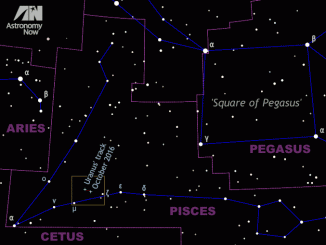
Have you ever seen Uranus with the naked eye? If not, moonless nights in October offer ideal conditions to test your visual acuity and sky clarity. Uranus reaches opposition on 15 October and attains a respectable altitude in the southern sky as seen from the British Isles. Here is our guide to tracking down the seventh planet from the Sun.
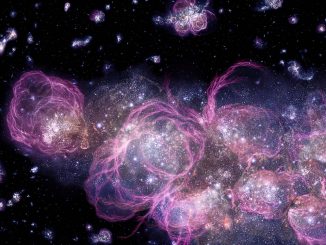
A new study comprised of 7,000 galaxies casts light on how young, hot stars ionise oxygen in the early universe and the effects on the evolution of galaxies through time. The study presents the first measurements of the changing strengths of oxygen emission lines from the present day and back to 12.5 billion years ago.
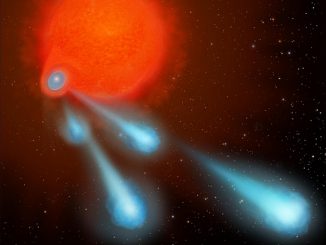
The NASA/ESA Hubble Space Telescope has detected superhot blobs of gas, each twice as massive as the planet Mars, being ejected near a dying red giant star in the V Hydrae binary system. The plasma balls are zooming so fast through space it would take only 30 minutes for them to travel from Earth to the Moon.

Astronomers have used NASA’s Chandra X-ray Observatory and ESA’s XMM-Newton X-ray observatory to discover an extremely luminous, variable X-ray source located outside the centre of its parent galaxy. This peculiar object could be a wandering black hole that came from a small galaxy falling into a larger one.
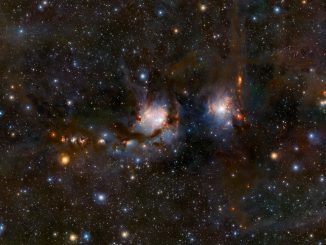
In this new image of the nebula Messier 78, young stars cast a bluish pall over their surroundings, while red fledgling stars peer out from their cocoons of cosmic dust. ESO’s Visible and Infrared Survey Telescope for Astronomy (VISTA) sees near-infrared light, which passes right through dust, permitting astronomers to probe deep into the heart of the stellar environment.
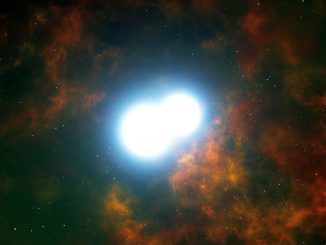
A new mathematical model created by astrophysicists at the American Museum of Natural History details a way that dead stars called white dwarfs could detonate, producing a type of explosion that is instrumental to measuring the extreme distances in our universe. The mechanism could improve our understanding of how Type Ia supernovae form.
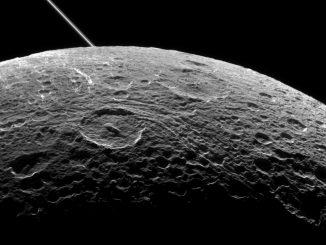
A subsurface ocean lies deep within Saturn’s moon Dione, according to new data from the Cassini mission. Two other moons of Saturn, Titan and Enceladus, are already known to hide global oceans beneath their icy crusts. Researchers believe that Dione’s crust floats on an ocean several tens of kilometres deep located 100 kilometres below the surface.
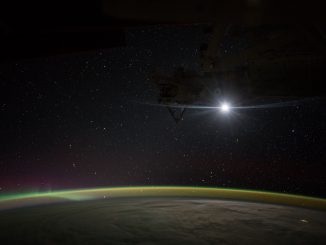
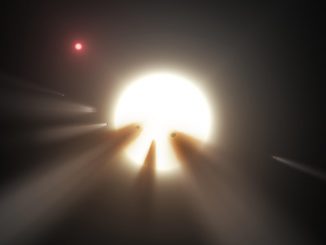
A star known as KIC 8462852 in the constellation Cygnus has been raising eyebrows both in and outside of the scientific community for the past year. In 2015 a team of astronomers announced that the star underwent a series of very brief, non-periodic dimming events while being monitored by NASA’s Kepler space telescope. A new study has deepened the mystery.
© 2026 Nebula Press Ltd