Archive
See planet Venus dazzle at greatest brilliancy in the pre-dawn sky
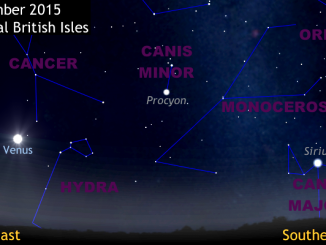
Early risers wishing to see Venus as a dazzling ‘morning star’ need only glance low to the east in the pre-dawn sky. The planet reaches greatest brilliancy on Sunday, 20 September when, for a couple of mornings, it can be seen outshining brightest nighttime star Sirius in the southeast by a factor of seventeen times. Can you see your shadow cast by Venus?
Watching an exoplanet in motion around a distant star
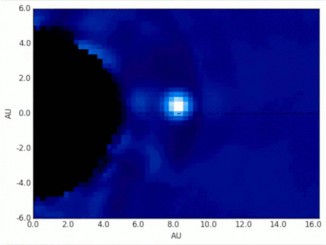
A team of astronomers, using the Gemini Planet Imager (GPI) on the Gemini South telescope in Chile, has given us our best view yet of an exoplanet moving in its orbit around a distant star. A series of images captured between November 2013 and April 2015 shows the exoplanet β Pictoris b as it moves through 1½ years of its 22-year orbital period.
Merging black holes responsible for mysterious flickering quasar
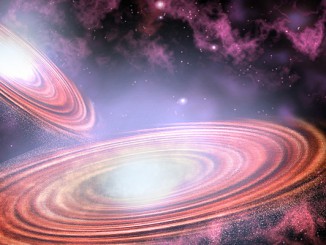
Columbia University astronomers provide additional evidence that a pair of closely orbiting black holes deep in the Virgo constellation is causing the rhythmic flashes of light coming from quasar PG 1302-102. Separated by a mere light-week, the black holes are spiralling toward a collision so powerful it will send a burst of gravitational waves surging through the fabric of space-time.
The Sculptor Dwarf Galaxy: a shy galactic neighbour
The Sculptor Dwarf Galaxy, pictured in this new image from ESO’s La Silla Observatory, is a close neighbour of the Milky Way. This galaxy is much smaller and older than ours, making it a valuable subject for studying both star and galaxy formation in the early universe. However, due to its faintness, studying this object is no easy task.
Dust discs of nearby red dwarfs could reveal planetary secrets
An accidental find of a collection of young red dwarf stars close to our solar system could give us a rare glimpse of slow-motion planet formation. Astronomers from The Australian National University and University of New South Wales, Canberra found large discs of dust around two of the stars, telltale signs of planets in the process of forming.
Cassini finds global ocean under icy crust of Saturn’s moon Enceladus
A global ocean lies beneath the icy crust of Saturn’s geologically active moon Enceladus, according to new research using data from NASA’s Cassini mission. Researchers found the magnitude of the moon’s very slight wobble, as it orbits Saturn, can only be accounted for if its outer ice shell is not frozen solid to its interior, meaning a global ocean must be present.
3000th comet discovered by Solar and Heliospheric Observatory (SOHO)
On 13 September 2015, the ESA/NASA Solar and Heliospheric Observatory (SOHO) discovered its 3,000th comet, cementing its standing as the greatest comet finder of all time. The comet was spotted in SOHO’s data by Worachate Boonplod of Thailand — a citizen scientist typical of the NASA-funded Sungrazer Project volunteers responsible for 95 percent of SOHO comet discoveries.
Shocks in a distant gamma-ray burst
Gamma ray bursts (GRBs) — flashes of high-energy light occurring about once a day, randomly, from around the sky — are the brightest events in the known universe. While a burst is underway, it is many millions of times brighter than an entire galaxy. Astronomers are anxious to decipher their nature as their tremendous brightness opens windows into the young universe.
“Moon and Antelao” by Marcella Giulia Pace
Our final nomination from the prestigious Insight Astronomy Photographer of the Year competition, an annual celebration of the most beautiful and spectacular visions of the cosmos by astrophotographers worldwide. The 2015 competition received 2700 spectacular entries from over 60 countries and the winners will be announced 17 September.