
News

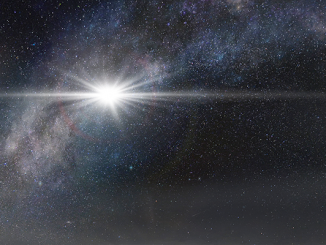
Records are made to be broken, as the expression goes, but rarely are records left so thoroughly in the dust. Stunned astronomers have witnessed a cosmic explosion about 200 times more powerful than a typical supernova — events which already rank amongst the mightiest outbursts in the universe — and more than twice as luminous as the previous record-holding supernova.
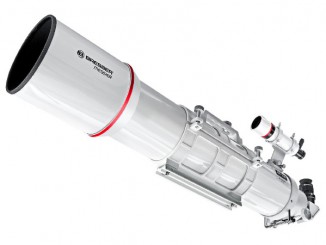
Reviewer Steve Ringwood takes a look through the Bresser Messier AR-152L/1200 — a classic achromatic doublet refractor of 152mm (six-inch) aperture and f/8 focal ratio. Available as an optical tube only with mounting rings, dovetail, carry handle, 8×50 finder, 26mm eyepiece, diagonal and T-adapter, the instrument employs Bresser’s bespoke Hex Focus system.

Zooming in on black holes is the main mission for the newly installed GRAVITY instrument at ESO’s Very Large Telescope in Chile. During its first observations, GRAVITY successfully combined starlight using all four 1.8-metre Auxiliary Telescopes. The first observations using GRAVITY with the four 8-metre VLT Unit Telescopes are planned for later in 2016.
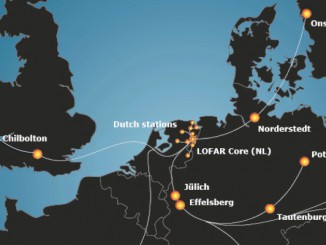
The world’s biggest connected radio telescope is about to become even bigger! A LOFAR (Low Frequency Array) station will be constructed this year on the grounds of Birr Castle, located centrally in Ireland. This is not only great news for Irish astrophysics, but also for the International LOFAR Telescope (ILT).

Features on dwarf planet Ceres that piqued the interest of scientists throughout 2015 stand out in exquisite detail in the latest images from NASA’s Dawn spacecraft, which recently reached its lowest-ever altitude at Ceres. Dawn took these images near its current altitude of 240 miles (385 kilometers) between 19 and 23 December 2015.
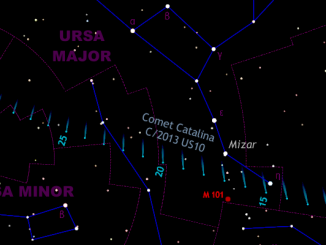
Having brushed by bright star Arcturus on 1 January, Comet Catalina (C/2013 US10) continues its trek through the constellations of the far north. Now a circumpolar object for the British Isles, in the early hours of 17 January it lies between famous double star Mizar (ζ Ursae Majoris) and the Pinwheel Galaxy (M101), virtually overhead in the UK.
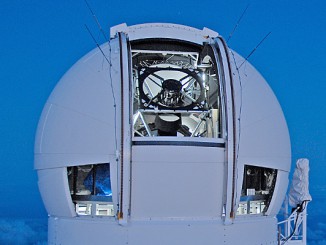
NASA has formalised its ongoing program for detecting and tracking near-Earth objects (NEOs) as the Planetary Defense Coordination Office (PDCO). The office will be responsible for supervision of all NASA-funded projects to find and characterise asteroids and comets that pass near Earth. It will also take a leading role in coordinating efforts in response to any potential impact threats.
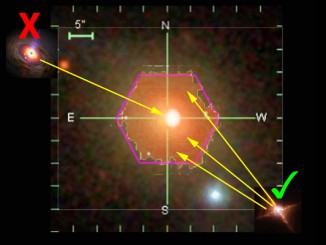
You might think that astronomers could easily tell the difference between a black hole and a white dwarf — but nature can be deceptive. Astronomers from the Sloan Digital Sky Survey (SDSS) have just announced the results of a new study that reveals the true origin of puzzling light from nearby galaxies.
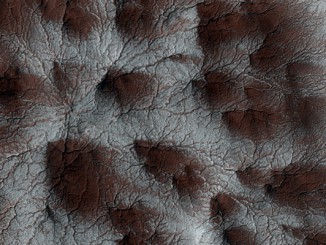
Mars’ seasonal cap of carbon dioxide ice has eroded many beautiful terrains as it sublimates (goes directly from ice to vapour) every spring. In the region where the High Resolution Imaging Science Experiment (HiRISE) camera on NASA’s Mars Reconnaissance Orbiter took this image, we see troughs that form a starburst pattern.
© 2019 Pole Star Publications Limited