News

Mysterious alignment of black holes discovered

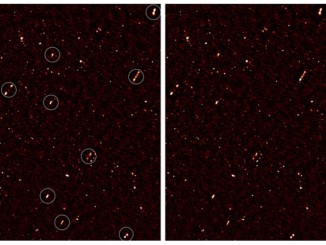
Deep radio imaging by researchers in the University of Cape Town and University of the Western Cape, in South Africa, has revealed that supermassive black holes in a region of the distant universe are all spinning out radio jets in the same direction — most likely a result of primordial mass fluctuations in the early universe.
News

Hot super-Earth atmospheres stripped by nearby host stars

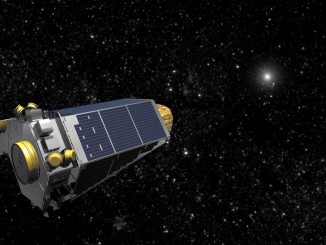
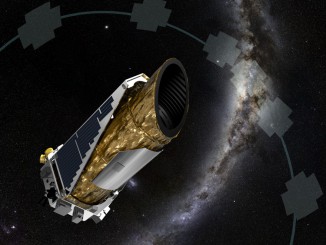
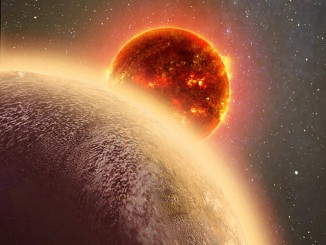
Astrophysicists at the University of Birmingham have used data from NASA’s Kepler space telescope to look at super-Earths, which are planets outside our solar system with a mass 1-10 times the mass of Earth. In particular, the researchers focused on hot super-Earths whose atmospheres have been stripped away by intense radiation from nearby host stars.

News

Climate change creates wobbles in Earth’s spin axis

Earth does not always spin on an axis running through its poles. Instead, it wobbles irregularly over time, currently drifting toward the British Isles at 17cm per year. These wobbles don’t affect our daily life, but they must be taken into account to get accurate results from GPS, satellites and observatories on the ground.

News

Searching for distant and wandering worlds

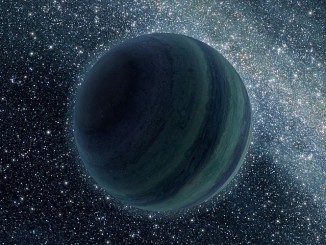
In a global exoplanet observation experiment, NASA’s Kepler K2 mission and Earth-based observatories on six continents hope to survey millions of stars toward the centre of our Milky Way galaxy. Using a technique called gravitational microlensing, scientists will hunt for exoplanets that orbit far from their host star and for free-floating exoplanets that wander between the stars.

News

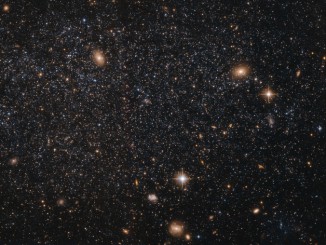
Where are the missing brown dwarfs?

Brown dwarfs are objects that are too large to be called planets, yet too small to shine by nuclear fusion. Two German researchers have taken a careful look at the distribution of nearby examples of these “failed stars” and to their surprise discovered a significant asymmetry in their spatial arrangement.

Observing

See the Moon invade the Hyades star cluster on 10 April

If you have a clear western horizon from shortly before 9pm BST until midnight on Sunday, 10 April, don’t miss an opportunity to see a young crescent Moon glide slowly through the southern edge of the Hyades star cluster in Taurus, covering (or occulting) stars as it goes. All you need is a typical binocular or a small telescope to enjoy the show!