
News

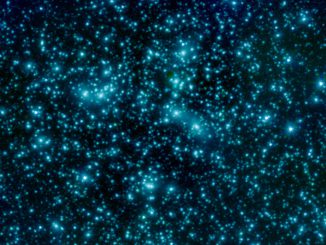
In the ongoing hunt for the universe’s earliest galaxies, NASA has wrapped up its observations for the Frontier Fields project. This ambitious venture has combined the power of all three of NASA’s orbital observatories — the Spitzer Space Telescope, the Hubble Space Telescope and the Chandra X-ray Observatory — to delve as far back in time and space as current technology can allow.
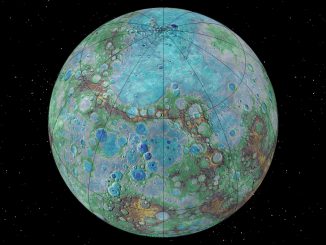
Images from NASA’s MESSENGER spacecraft reveal previously undetected cliff-like landforms on Mercury that scientists believe must be geologically young, which means that the innermost planet is still contracting and that Earth is not the only tectonically active planet in our solar system, as previously thought.
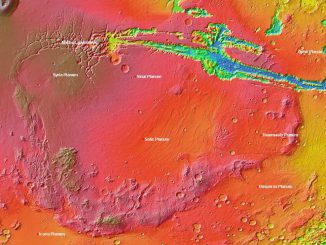
Researchers studying the geography and mineralogy of an area on Mars known as Thaumasia Planum, based on Gamma Ray Spectrometer data collected by the Mars Odyssey Orbiter launched in 2001, have found that the mountain ridge outlining Greater Thaumasia was most likely created by a chain of ancient volcanoes.
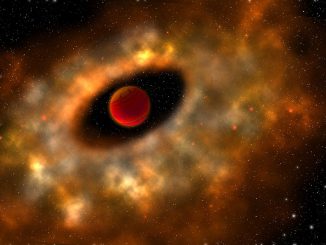
Astronomers like to find rotating primordial discs of gas and dust around young stars from which planets can form. They might be able to catch the star partway through the planet-formation process, but it’s highly unusual to find such discs around brown dwarfs or stars with very low masses. Now, recent work reveals four new low-mass objects surrounded by discs.
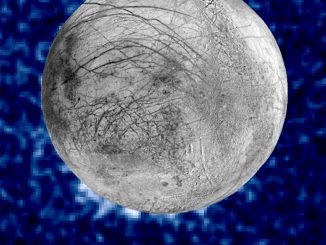
Astronomers using NASA’s Hubble Space Telescope have imaged what may be water vapour plumes erupting 125 miles (200 kilometres) off the surface of Jupiter’s moon Europa. Europa has a huge global ocean containing twice as much water as Earth’s oceans, but it is protected by a layer of extremely cold and hard ice of unknown thickness.
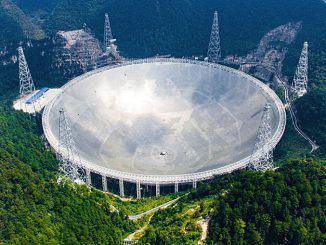
The world’s largest filled single-dish radio telescope launched at the weekend, and it relies on a piece of West Australian innovation. The 500-metre-wide telescope — known as FAST — uses a data system developed at the International Centre for Radio Astronomy in Perth and the European Southern Observatory to manage the huge amounts of data it generates.
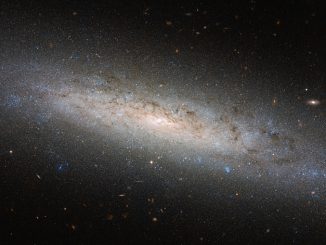
This glorious spiral galaxy is known as NGC 24, measures some 40,000 light-years across and lies about 25 million light-years away in the southern constellation of Sculptor. However, there may be more to this picture than first meets the eye: 80 percent of NGC 24’s mass is thought to be held within an invisible dark matter halo.
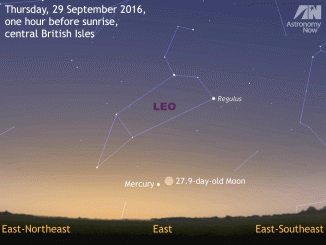
Mercury is currently putting on a fine show in the east before dawn. Find a UK location with an unobstructed view due east an hour before sunrise to see the innermost planet some 6 degrees above the horizon from about 25 September—5 October. The very old crescent Moon lies just 2 degrees from Mercury at dawn on Thursday, 29 September.
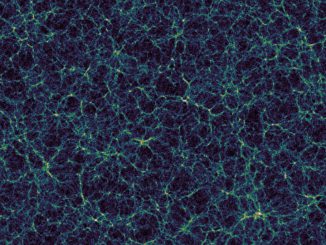
The universe is expanding uniformly according to research led by University College London (UCL). The researchers studied the cosmic microwave background (CMB) which is the remnant radiation from the Big Bang. It shows the universe expands the same way in all directions, supporting the assumptions made in cosmologists’ standard model of the universe.
© 2026 Nebula Press Ltd