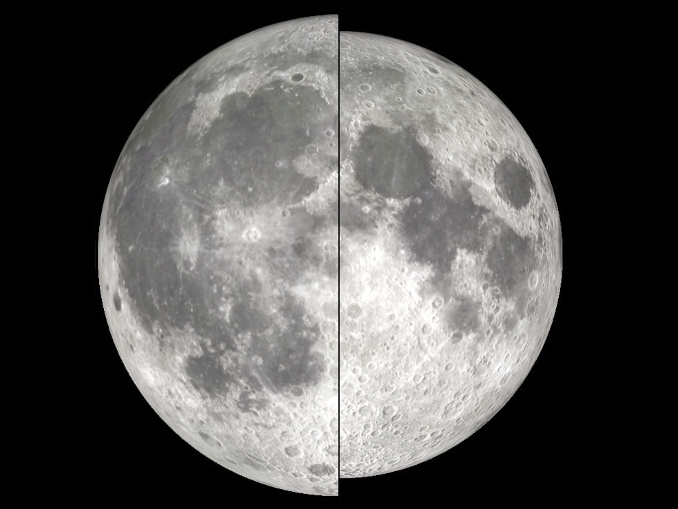
The full Moon of 19 February occurs just 6¾ hours after perigee, its closest point to Earth in the oval-shaped lunar orbit. This graphic shows the apparent size of this full Moon (left), almost 8 percent larger than on average (right). A full Moon occurring close to perigee is popularly called a supermoon, though astronomers prefer the less catchy term ‘perigee-syzygy of the Earth–Moon–Sun system’. The supermoon of 19 February is the closest full Moon of the year and we’ll not see one larger until Christmas Eve 2026. AN graphic by Ade Ashford.If your eastern sky is clear at dusk on 19 February be sure to take a good look at the full Moon rising in the constellation of Leo. If it seems a bit bigger than usual then it’s due to more than just the lunar illusion, for this full Moon is the largest that you’ll see all year.
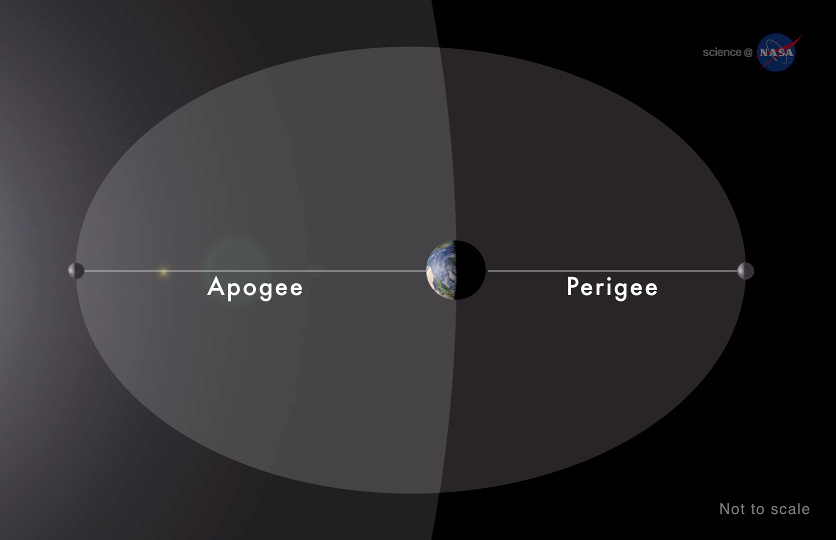
The Moon’s orbit around Earth is slightly elliptical so sometimes it is closer and sometimes it’s farther away. When the Moon is full as it makes its closest pass to Earth it is known as a supermoon. At perigree — the point at which the moon is closest to Earth — the Moon can be as much as 14 percent closer to Earth than at apogee, when the Moon is farthest from our planet. The full Moon appears that much larger in diameter and because it is larger shines 30 percent more moonlight onto the Earth. Image credit: NASA.The Moon’s orbit is far from circular and its distance from Earth at closest approach, termed perigee, varies each lunar month. Tuesday, 19 February at 9:09 UT (9:09am GMT) sees the closest perigee of 2019 when the distance between centres of Earth and Moon is 356,763 kilometres. And the Moon won’t get any nearer Earth until 21 January 2023. Yet even this record will be surpassed by the 356,447-kilometre perigee of 6 December 2052 – the closest of the century.
The circumstances of 2019’s closest Moon get a little more interesting a few hours later on 19 February since full Moon occurs at 15:54 UT (3:54pm GMT). The proximity of perigee and a full Moon – giving rise to a lunar orb almost 8 percent larger than average on this occasion – is commonly called a supermoon, which is far more succinct than the term ‘perigee-syzygy of the Earth–Moon–Sun system’ preferred by astronomers.
Watch the supermoon live courtesy of the Virtual Telescope Project
Not only is next Tuesday’s full Moon the largest of 2019, but it’s also the third-largest full Moon of the next 10 years. In fact, you’ll have to wait until Christmas Eve 2026 to see a larger full Moon (calculated for the geocentre).
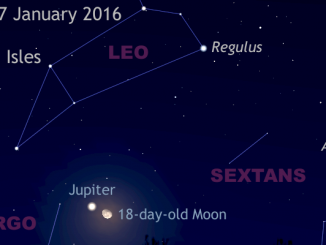
Observers in the British Isles and western Europe with a clear sky low to the east around 10pm local time on Wednesday, 27 January can see the rising 18-day-old waning gibbous Moon in a close conjunction with Jupiter, the solar system’s largest planet. Jupiter draws steadily closer to Earth and grows in apparent size over the coming weeks.
Now that planet Saturn is effectively lost in the dusk twilight for UK-based observers, you may be wondering what has happened to the other four bright naked-eye planets. Far from disappearing, they have just transferred to the morning sky. From 8—11 October, the waning crescent Moon acts as a guide to Venus, Mars, Jupiter then Mercury in the eastern dawn sky.
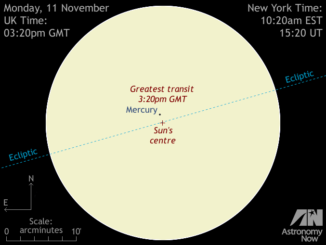
On Monday, 11 November 2019 just after 12:30pm GMT, suitably equipped observers in the British Isles can witness the start of a 3.7-hour spectacle that hasn’t been seen for three-and-a-half years — the silhouette of innermost planet Mercury crossing the face of the Sun. Here’s our online guide to observing this fascinating and comparatively rare event in complete safety.