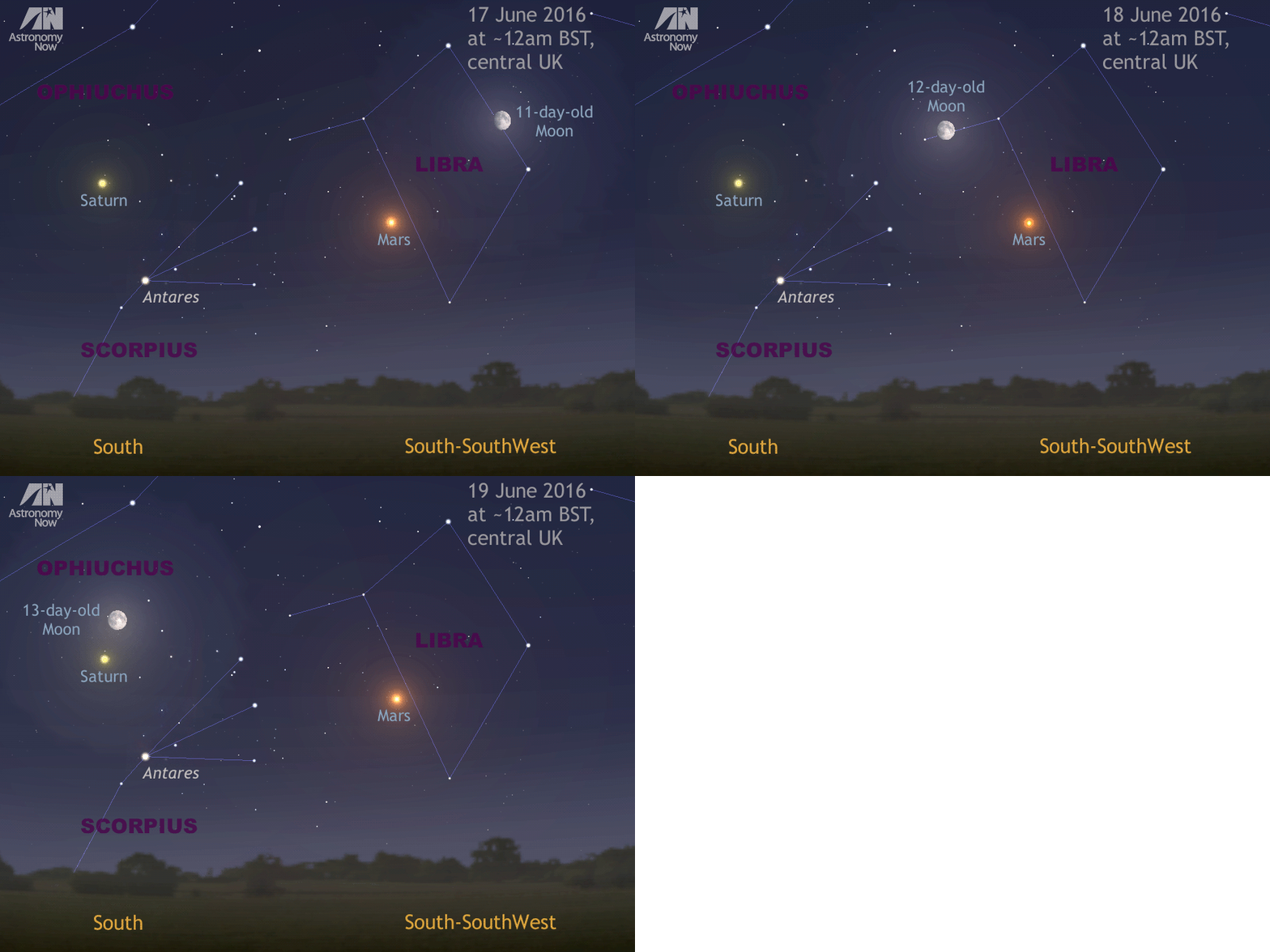
Skywatchers in the UK and Western Europe should look low in the southern sky at 12am local time on 17, 18 and 19 June to see the waxing gibbous Moon in the vicinity of planets Mars and Saturn, plus first-magnitude star Antares in the constellation of Scorpius. This looping animation shows the passage of the Moon through this region of sky at the stated times for an observer in the centre of the British Isles. For scale, the view is 40 degrees wide, or twice the span of an outstretched hand at arm’s length. Note that the Moon’s size has been slightly enlarged for clarity. Click the graphic for a full-size version. AN animation by Ade Ashford.In an earlier post, I drew your attention to the Moon‘s close approach to Jupiter at dusk on 11 June, essentially the planet’s swan song of this apparition. Six nights later, the Moon’s orbital motion brings it between two prime-time planets: Mars and Saturn.
The Red Planet was closest to Earth at the end of May (see this story for the details), so it is still at its best during 2016, despite the very low altitude as seen from the UK. Currently highest in the sky due south at dusk, ochre-colour Mars is shining at magnitude -1.8 — brighter than any star.
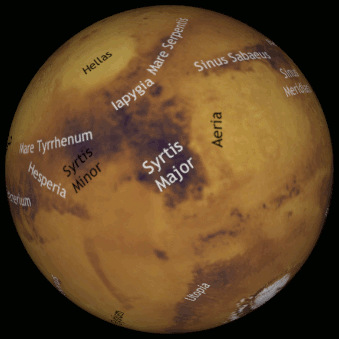
This labelled computer-generated map of the Red Planet obtained through our interactive Mars Mapper app shows the Martian hemisphere facing Earth mid-June at around 11:30pm BST. The map has south up and east to the right. Click the graphic to launch Mars Mapper in a new window. AN graphic by Ade Ashford.Late into the night of Friday, 17 June, when the gibbous lunar disc is close to Mars, the planet has an angular diameter slightly less than 18 arcseconds. This means that the Red Planet requires a telescope magnifying 100x to enlarge it to the same size as the Moon appears to the unaided eye. You can use our interactive Mars Mapper to help identify Martian surface features. Note that the planet’s prominent v-shaped Syrtis Major is well placed mid-month for observers in the British Isles.
Ringed planet Saturn was at opposition on 3 June, so it is still at its closest to Earth for the year. Like Mars, the planet’s low altitude as seen from the UK will mean that poor seeing will make observations challenging, but on slightly misty nights when a high pressure weather system sits overhead, the jewel of the planets is still an arresting sight. At 18 arcseconds in diameter, Saturn’s disc is currently fractionally larger than Mars, while the northern aspect of its 42-arcsecond-wide ring system is prominently displayed.
Inside the magazine
Find out all you need to know about what is currently happening in the night sky and how to observe it in the June 2016 edition of Astronomy Now.
NASA’s Cassini spacecraft has observed geysers erupting on Saturn’s icy moon Enceladus since 2005, but the process that drives and sustains these eruptions has remained a mystery. Now, scientists have pinpointed a mechanism by which cyclical tidal stresses exerted by Saturn can drive Enceladus’s long-lived eruptions.
There’s a lot of planetary activity in the dawn sky in mid-April. If you’re an early riser in the British Isles, let the waning crescent Moon be your guide to the naked-eye planets Jupiter, Saturn and Mars on 15 and 16 April 2020. Typical 7×50 or 10×50 binoculars will show these attractive conjunctions well, while the smallest of telescopes also reveal some of Jupiter’s bright Galilean moons.
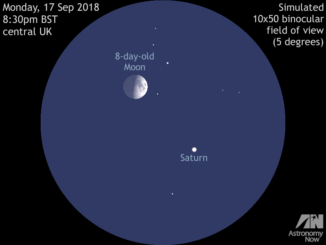
Skywatchers in the UK looking to the south-southwest at dusk on Monday, 17 September can see the waxing gibbous Moon just 1¾ degrees to the upper left of Saturn, the pair fitting comfortably in the same field of view of binoculars and small telescopes magnifying 25× or less. This is also a good night for spotting Titan, Saturn’s largest and brightest moon.