Observing

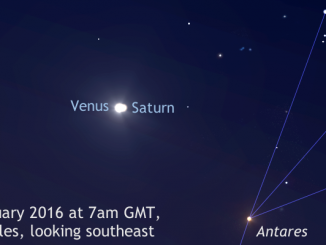
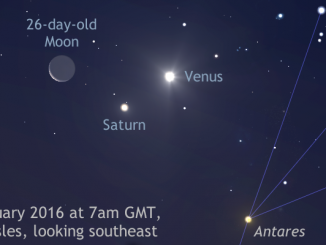
See Venus and Saturn get close on the morning of 9 January

On the morning of Saturday, 9 January — just two days after their photogenic conjunction with an old crescent Moon — planets Venus and Saturn reach the denouement of their pre-dawn show with a spectacular close conjunction. To observe this spectacle you need an unobstructed view low to the southeast around 7am GMT (central British Isles).

Observing

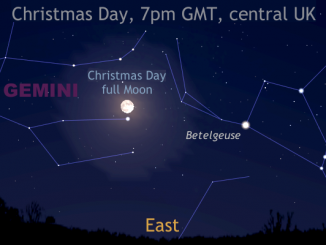
See a rare full Moon on Christmas Day

As darkness descends on 25 December 2015, a rather special Moon can be seen rising in the east, since this is the first full Moon to occur on Christmas Day since 1977. Let us hope that the weather is favourable, for we have rather a long wait until the next — 2034. Season’s greetings from everyone at Astronomy Now!

Observing

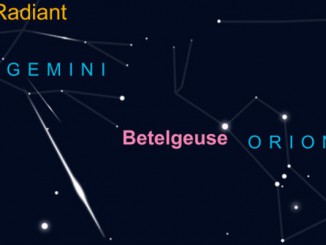
Get ready for the Geminid meteor shower!

The Geminids of 8—17 December are widely regarded as the most active and consistent annual meteor shower, with peak predicted rates of 100 shooting stars per hour under dark skies. With new Moon occurring on Friday, 11 December, prospects for this year’s Geminid display are therefore expected to be very favourable — UK weather permitting!

Observing

See star λ Geminorum’s lunar hide and seek on 29 November

Early risers in the northeast of England and Scotland with clear skies can see naked-eye star lambda (λ) Geminorum, otherwise known as Alkibash, slip behind the southern polar regions of an 18-day-old waning gibbous Moon close to 5am GMT on Sunday, 29 November. However, for a select number of northern observers this will be a special grazing lunar occultation.