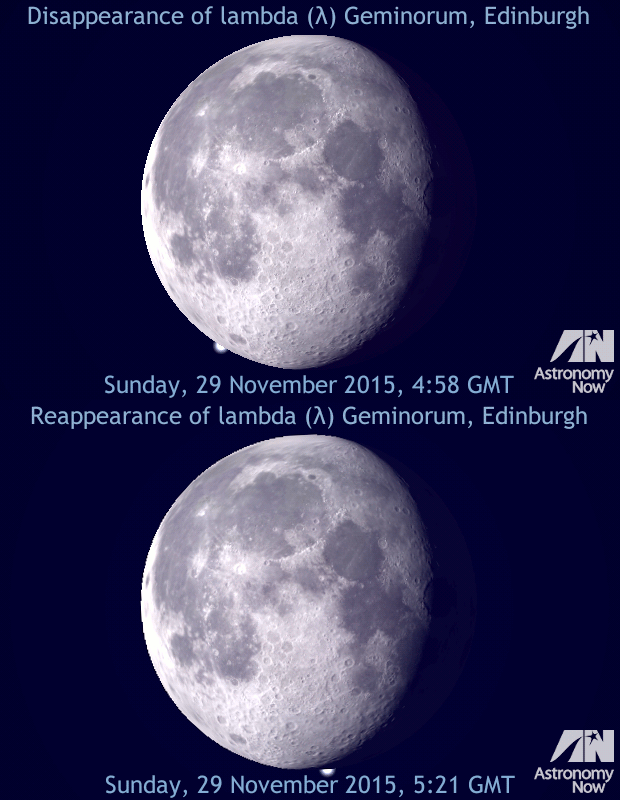
This looping animation represents a computer simulation of the occultation of magnitude +3.6 double star lambda (λ) Geminorum as seen from Edinburgh on the morning of Sunday, 29 November 2015. From the Scottish capital, the star — also known by its proper name of Alkibash — disappears at the southern lunar limb just before 4:58am GMT and reappears by 5:21am GMT. As described in the text, this event is visible as a grazing lunar occultation further south in the British Isles. AN animation by Ade Ashford.Early risers in the northeast of England and Scotland blessed with clear skies will see naked-eye star lambda (λ) Geminorum, otherwise known as Alkibash (α=07h18.1m δ=+16°32′ J2000), slip behind the southern polar regions of an 18-day-old waning gibbous Moon close to 5am GMT on Sunday, 29 November. The occultation will take place some 40 degrees above the southwest horizon in a dark sky for the north of the UK.
If one is situated exactly on the graze line, the telescopic view of a moderately bright star winking in and out of sight as it is alternately hidden by mountains on the southern limb of the Moon then exposed again as it shines through a lunar valley affords an awesome demonstration of the orbital motion of the Moon. If a star happens to be a double — as lambda (λ) Geminorum is — the spectacle is enhanced as you have two points of light flickering on and off!
The grazing occultation time and line is predicted to run through south Campbeltown (5:07am), Galloway Forest Park (5:09am), Penrith (5:12am), Thirsk (5:14am) and Driffield (5:16am; all times GMT).
For some large centres of population north of the graze line, the full occultation disappearance (D) and reappearance (R) times for the star are: Glasgow (D 4:59am, R 5:18am); Edinburgh (D 4:57am, R 5:20am); Berwick-upon-Tweed (D 4:59am, R 5:23am); Newcastle upon Tyne (D 5:04am, R 5:21am); Stockton-on-Tees (D 5:07am, R 5:19am) and Scarborough (D 5:09am, R 5:20am).
As always, with any sort of occultation observation, ensure that you are setup and viewing a few minutes before the predicted time(s) so as not to miss anything. Clear skies!
Inside the magazine
You can find out more about this month’s lunar and stellar events in the November edition of Astronomy Now in addition to a full guide to the night sky.
Observers in the British Isles and Western Europe should look low to the east about an hour before sunrise on Wednesday, 18 October to see the slim crescent of a very old Moon close to the brightest planet, Venus. Mars is also nearby for the keen-eyed among you, but don’t leave it too late or the growing twilight will drown out the Red Planet.