Observing

View the International Space Station at its best from the UK

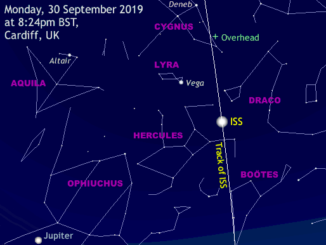
If you have never seen the International Space Station (ISS), make the most of clear skies over the next few nights. It’s capable of exceeding Venus at its brightest and visible for up to 7 minutes as it crawls across the sky in an arc from west to east. Find out when and where to see some favourable passes of this 420-tonne, 109-metre-wide spacecraft over the British Isles and Western Europe.

Observing

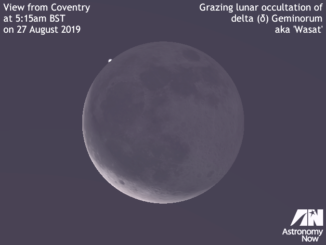
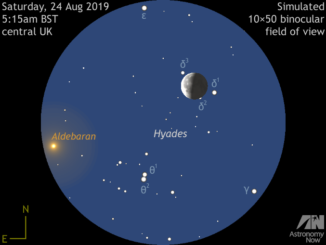
Watch the crescent Moon graze a double star at dawn on 27 August

Depending on where you live in the British Isles, you may be fortunate to view a lunar occultation of naked-eye double star delta (δ) Geminorum at dawn on Tuesday, 27 August 2019. Observers fortunate enough to lie on the so-called graze line will see the star appear to flicker on and off as the mountains and valleys of the northern lunar polar regions drift by.

Observing

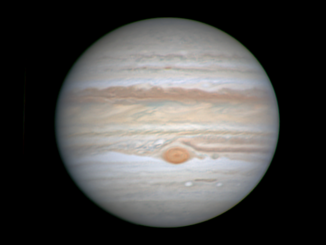
More Jupiter events to enjoy in August 2019

Jupiter is two months past opposition on 10 August, so you need to be looking low in the southern sky of the British Isles around sunset if you wish to catch the solar system’s largest planet at its best. If you time it right and the weather obliges, Jupiter’s Great Red Spot makes multiple appearances while the planet’s Galilean moons play hide and seek. Welcome to our August 2019 Jovian observing guide.

Observing

Seek out some fine summer multiple stars

Observers in the British Isles can rejoice that summer astronomical twilight all night is drawing to a close. But if Jupiter and Saturn are currently too low to view, you’re blighted by light pollution, or moonlight robs you of nebulae, why not seek out some of the many beautiful double and multiple stars on show?

Observing

See the International Space Station above the eclipsed Moon on 16 July

The serene beauty of the International Space Station gliding silently across the sky needs nothing more than the naked eye to appreciate. But when the dazzling ISS is also in conjunction with a partially eclipsed Moon, Saturn and Jupiter on the 50th anniversary of Apollo 11’s launch, be sure to look low in the southeast through south around 10:06pm BST on 16 July 2019!