
9 September 2026
Astronomy Now
  • Home
  • The Magazine
    • About
    • Current Issue
    • Subscribe
    • Renew Subscription
  • AstroFest 2026
  • News
  • Observing
    • UK Sky Chart
    • Almanac
    • Scope Calc
    • DSLR Calc
  • Reviews
    • Equipment
    • Book Reviews
  • Spaceflight Now
  • Shop
  • Contact Us
    • Subscriptions
    • Your Views
    • Ask Astronomy Now
    • Editorial
    • Advertising
    • AstroListings
Latest News
  • [ 8 September 2026 ] 3I/ATLAS was born in the deep freeze News
  • [ 30 August 2026 ] Roman Space Telescope launches on mission to survey the Universe News
  • [ 24 August 2026 ] JWST’s ‘impossible’ early galaxies may be even more massive than we thought News
  • [ 7 August 2026 ] How to observe the 12 August 2026 solar eclipse Eclipse
  • [ 5 August 2026 ] Falcon 9 lunar impact: More than a new crater News
  • Facebook
  • Twitter
  • LinkedIn

News

News

Astronomy Now relaunches digital platform

12 September 2025 Emily Baldwin-Fiebrich

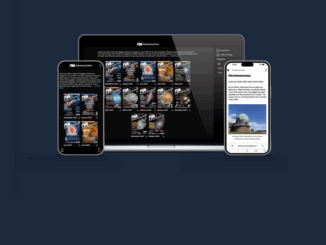
We are pleased to announce that our new Astronomy Now app is live! Since taking ownership of the magazine in July, creating an enhanced digital experience has been a high priority for our new Astronomy Now team.
News

Potentially habitable planet TRAPPIST-1e displays tentative evidence for an atmosphere

8 September 2025 Stuart Clark

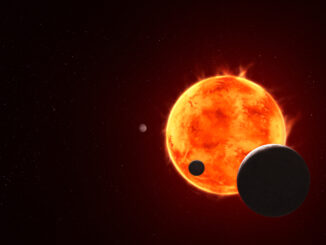
Astronomers have seen tentative evidence for an atmosphere on TRAPPIST-1e, a rocky planet 40 light years away.

News

Ten-Year Lease Extension Confirmed at Herstmonceux Observatory

18 August 2025 Emily Baldwin-Fiebrich

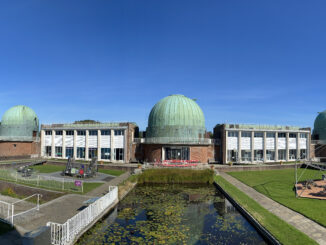
The announcement, on 18 August, follows a year of uncertainty after Queen’s University Canada declared that the lease to the current operators of the science centre, Science Projects, would not be renewed after December 2026.

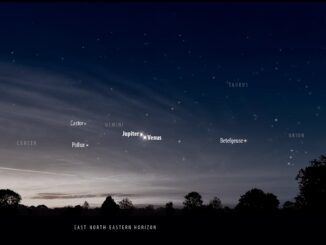
Graphic showing the close conjunction of Jupiter and Venus with other stars and contellations marked on a dark sky, above a horizon with trees in silhouette.
News

Venus and Jupiter’s bright morning conjunction

10 August 2025 Emily Baldwin-Fiebrich

Get ready for a clash of the titans when Venus and Jupiter, the two brightest planets in our Solar System, come together for a dazzling event visible across the length and breadth of the UK in the early hours of Tuesday morning.

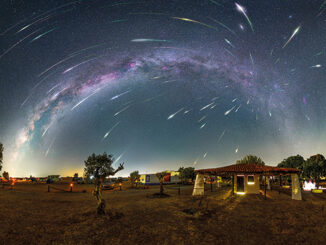
A stunning night sky composite photograph shows dozens of bright Perseid meteors streaking across the sky above a rural landscape, with the Milky Way arching overhead. The foreground features trees, a house, and softly lit structures, creating a serene countryside scene.
News

It’s time again for Perseid meteors!

8 August 2025 Emily Baldwin-Fiebrich

August means the Perseids: the annual shooting star spectacular reaches its peak to wow meteor enthusiasts with abundant bright events, writes Astronomy Now’s Night Sky manager Mark Armstrong.

News

Lonely giant planets may form their own planetary systems

30 July 2025 Stuart Clark

Planets without stars may not be so lonely after all. New research led by astronomers at the University of St Andrews suggests that free-floating giant planets—those adrift in interstellar space—can host their own miniature planetary systems.

News

Congratulations Professor Michele Dougherty – our new Astronomer Royal

30 July 2025 Stuart Clark

His Majesty The King has approved Professor Michele Dougherty as the new Astronomer Royal. Professor Dougherty will be the sixteenth person and the first woman to hold this role since its creation 350 years ago.

Stuart Clark and Steven Young shake hands after signing the Astronomy Now contract.
News

Astronomy Now under new ownership

18 July 2025 Stuart Clark

We have some exciting company news we’d like to share with you… Today we’re starting a new chapter in the Astronomy Now story, as we relaunch under new management (plot twist ahead!).

universe
News

Is the Hubble Tension Resolved?

9 June 2025 Astronomy Now

New measurements from Hubble and Webb suggest the Hubble tension may be resolved, with expansion rates aligning and the standard model of cosmology remaining intact—for now.

The Universe
News

Universe’s end – sooner rather than later

16 May 2025 Astronomy Now

The universe may end far sooner than expected—within 10⁷⁸ years, not 10¹⁰⁰—according to Dutch researchers who reinterpreted Hawking radiation, suggesting all massive objects gradually decay over time.

Posts pagination

« 1 2 3 4 … 219 »

Latest Issue

Astronomy Now Newsletter

Get the wonders of the Universe delivered to your inbox. Sign up before 24 September for a 10% discount code for your Stargazer's Guide 2027!
* indicates required
Which elements of Astronomy interest you?

News Headlines

  • 3I/ATLAS was born in the deep freeze
    8 September 2026
  • Roman Space Telescope launches on mission to survey the Universe
    30 August 2026
  • JWST’s ‘impossible’ early galaxies may be even more massive than we thought
    24 August 2026
  • How to observe the 12 August 2026 solar eclipse
    7 August 2026
  • Falcon 9 lunar impact: More than a new crater
    5 August 2026

© 2026 Nebula Press Ltd

Astronomy Now