Equipment

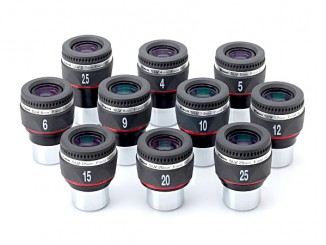
Vixen SLV eyepieces

Steve Ringwood takes a good look through Vixen’s SLV range of eyepieces, offered in ten focal lengths from 2.5mm to 25mm. Each is designed to offer exceptional clarity and contrast across a 45°—50° field by employing rare earth Lanthanum glass. He also notes that each eyepiece’s polygonal rubber grip acts as an ‘anti-roll’ feature, hopefully protecting them from a fall!

News

Scientists solve age-old planetary ring riddle

An international team of scientists has solved an age-old scientific riddle by discovering that planetary rings, such as those orbiting Saturn, have a universally similar particle distribution. The study also suggests that Saturn’s rings are essentially in a steady state that does not depend on their history.

News

Large galaxies’ appetite for growth revealed in streams of stars

An international team of astronomers has used a highly sensitive instrument on one of the world’s largest telescopes to witness a dominant galaxy, Messier 81 in Ursa Major, ingesting the stars of its near neighbours. The gravitational pull of M81 was shown to distort the shapes of adjacent galaxies, pulling their stars into long tails in a process called tidal stripping.

Picture This

The ghost of a dying star — the Southern Owl Nebula

This extraordinary bubble, glowing like the ghost of a star in the haunting darkness of space, may appear supernatural and mysterious, but it is a familiar astronomical object: a planetary nebula, the remnants of a dying star. This is the best view of the little-known object ESO 378-1 yet obtained and was captured by ESO’s Very Large Telescope in northern Chile.

News

Neutron star takes on black holes in jet contest

A team of scientists in Australia and the Netherlands has discovered powerful jets blasting out of a star system known as PSR J1023+0038 that consists of a super-dense neutron star in a close orbit with another, more normal star. It was previously thought that the only objects in the universe capable of forming such powerful jets were black holes.

News

Tracking a mysterious group of asteroid outcasts

High above the plane of our solar system, near the asteroid-rich abyss between the orbits of Mars and Jupiter, scientists have found a unique family of space rocks. These interplanetary oddballs are the Euphrosyne (pronounced ew-FROZ-i-nee) asteroids, and by any measure they have been distant, dark and mysterious — until now.