
Credit: Lea Ferellec (CC BY 4.0)
The more astronomers learn about interstellar comet 3I/ATLAS, the colder its birthplace appears to have been.
New observations made with the William Herschel Telescope (WHT) on La Palma in the Canary Islands have revealed unusually large quantities of nitrogen in the comet’s gasseous plasma tail. The result suggests that 3I/ATLAS formed at temperatures below about –240°C, far from the star around which it was born.
The finding adds an independent line of evidence to earlier studies of 3I/ATLAS, which have also pointed towards formation in an extremely cold environment beyond our Solar System.
‘This object gives us a rare chance to study material that formed somewhere completely different to our own Solar System,’ says study leader Lea Ferellec of Northumbria University.
‘Finding that it’s so rich in nitrogen tells us it likely formed in extremely cold conditions, far from its home star.’
Ferellec and her colleagues Cyrielle Opitom and Colin Snodgrass used the new WEAVE spectrograph on the 4.2-metre WHT to study gases streaming away from 3I/ATLAS as the comet moved away from the Sun.
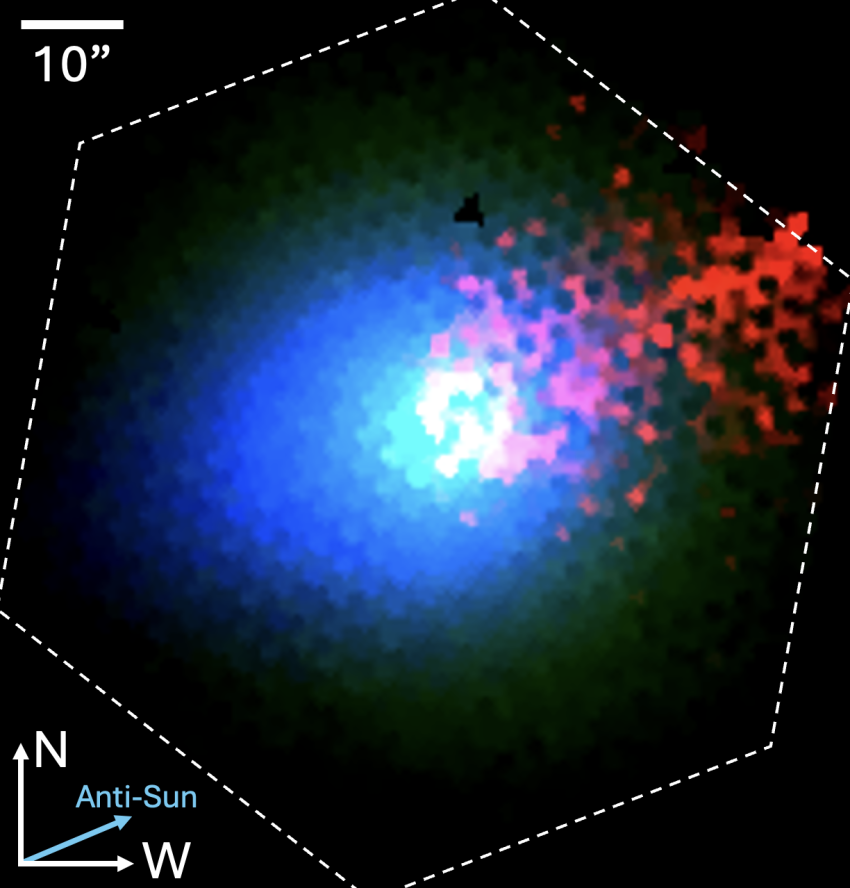
As sunlight heats a comet, gases released from its nucleus can become electrically charged, or ionised. These ions are then swept away by the solar wind to form a plasma tail. By spreading the tail’s light into a spectrum, astronomers can identify the different ions within it.
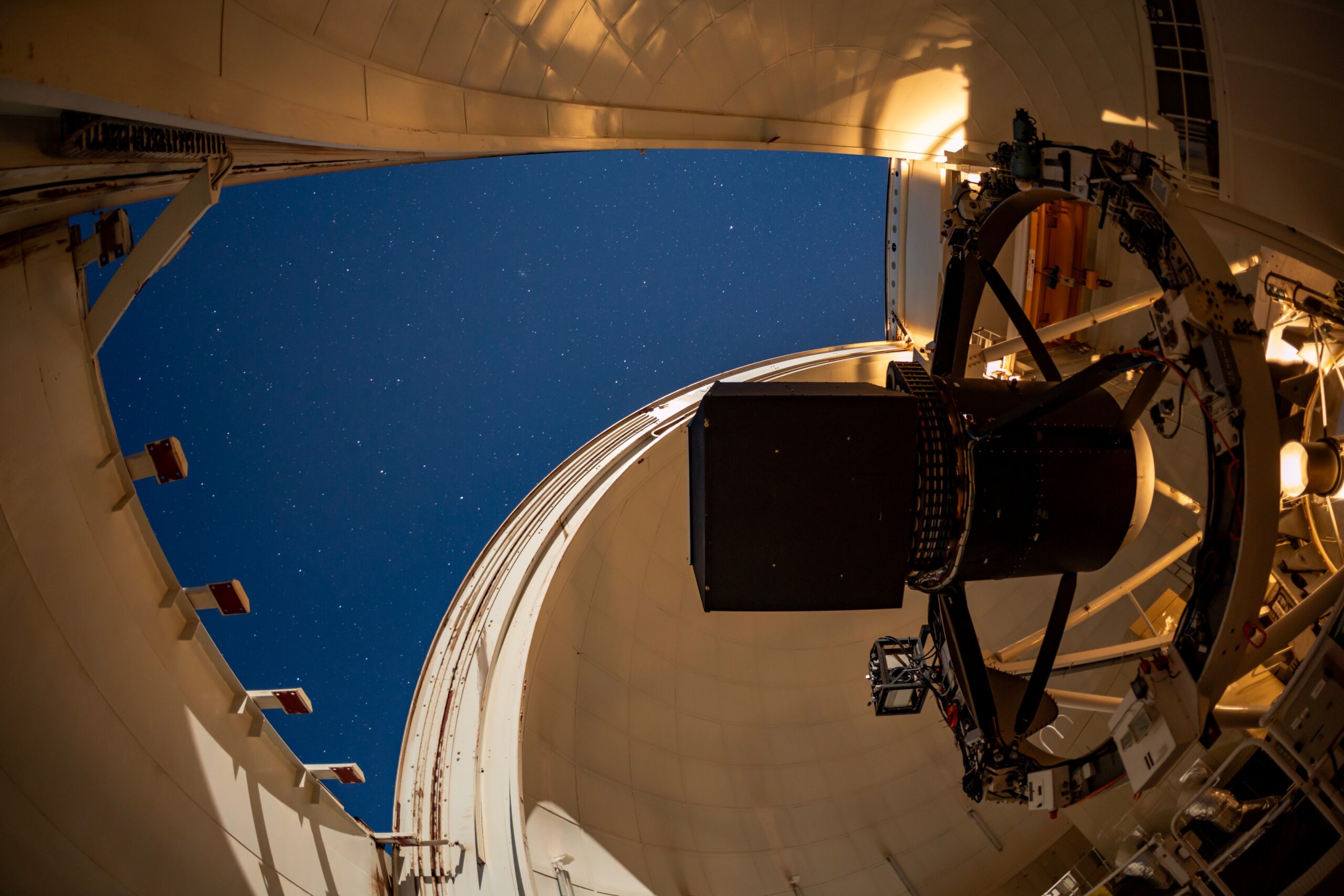
WEAVE simultaneously detected five ions in the tail of 3I/ATLAS, an unusual achievement even for comets belonging to our own Solar System and a first for an interstellar object. Crucially, the team was able to measure the abundance of ionised molecular nitrogen, N₂⁺, relative to ionised carbon monoxide, CO⁺.
The amount of nitrogen preserved in a comet is particularly sensitive to the temperature at which its ices originally formed. The unusually high ratio found in 3I/ATLAS points to temperatures below about 33 kelvin (–240°C), placing its formation far out in the frozen reaches of its original planetary system.
The researchers were also able to trace how the different ions changed with distance along the comet’s tail, the first time this level of detail has been achieved for an interstellar object.
3I/ATLAS was discovered in July 2025 and is only the third confirmed interstellar object to pass through our Solar System, following 1I/‘Oumuamua in 2017 and comet 2I/Borisov in 2019. Because such objects formed around other stars before being expelled into interstellar space, their chemistry provides astronomers with a rare opportunity to compare the raw materials of other planetary systems with our own.
‘Every one of these objects we study helps us understand a little more about how planets form around other stars,’ said Ferellec.
The research is published in Monthly Notices of the Royal Astronomical Society.