
News


Comet Catalina (C/2013 US10) is currently a morning object in Virgo low in the southeast before dawn twilight for UK observers. The comet has a photogenic close encounter with Venus and the waning crescent Moon on the mornings of 7—8 December, then rapidly heads north through the constellation Boötes for a closer brush with Arcturus on New Year’s Day.

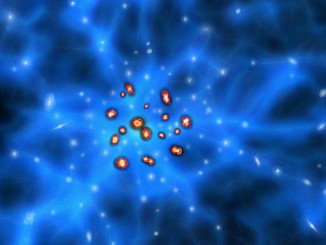
Astronomers using the Atacama Large Millimetre/submillimetre Array (ALMA) have discovered a nest of colossal baby galaxies 11.5 billion light-years away. The young galaxies seem to reside at the junction of gigantic filaments in a web of dark matter. These findings are important for understanding how enormous galaxies like these are formed and how they evolve into huge elliptical galaxies.
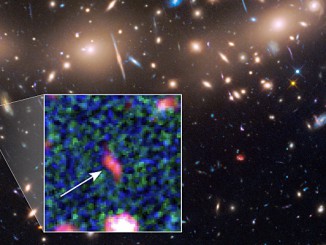
Astronomers harnessing the combined power of NASA’s Hubble and Spitzer space telescopes have found the faintest object ever seen in the early universe. It existed about 400 million years after the big bang, 13.8 billion years ago. The new object is comparable in size to the Large Magellanic Cloud (LMC), a diminutive satellite galaxy of our Milky Way.


It is almost five months since New Horizons’ epic encounter with Pluto, but the captured images and data will stream back to Earth across 3 billion miles of interplanetary space for a further 11 months. The first in a series of the best close-ups of the dwarf planet that humans may see for decades have been released, obtained when the spacecraft was just 15 minutes before closest approach during the 14 July flyby.
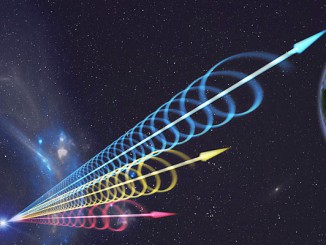
Fast radio bursts (FRBs), brief yet brilliant eruptions of cosmic radio waves, have baffled astronomers since they were first reported nearly a decade ago. Though they appear to come from the distant universe, none of these enigmatic events has revealed more than the slimmest details about how and where it formed, until now.


A binary star known as KIC 9655129 observed by NASA’s Kepler space telescope is known to produce superflares, thousands of times more powerful than those ever recorded on the Sun. Research led by the University of Warwick suggests the underlying physics of KIC 9655129’s superflares and solar flares might be the same, supporting the idea that our Sun could also produce such phenomena.
© 2019 Pole Star Publications Limited