Eclipse

Get ready for the 9 March total solar eclipse

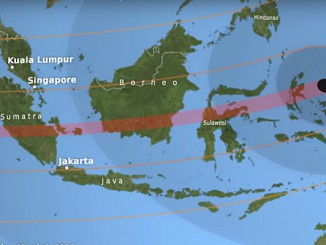
The Moon will pass in front of the Sun on 9 March 2016 UT, casting its shadow over much of Southeast Asia. The path of totality, in which all of the Sun’s bright face is blocked by the Moon, is nearly 100 miles wide as it crosses Indonesia, while the partial phases can be seen from East Asia, Australia and the Pacific Ocean. Here is our detailed guide.

Eclipse

Watch the 9 March total solar eclipse live

If you left it too late to book your Indonesian flight to view the total solar eclipse on the morning of Wednesday, 9 March (UT), don’t despair — put away your passport, sit back and enjoy the spectacle online, courtesy of Exploratorium and NASA TV. For virtual eclipse viewers in the UK, the event starts at 1am GMT on 9 March.

Eclipse

NASA science during the 9 March total solar eclipse

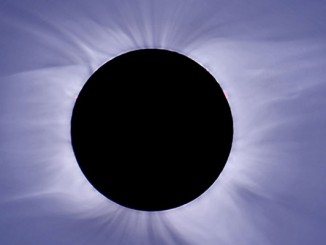
As the Moon slowly covers the face of the Sun on the morning of 9 March, a team of NASA scientists in Indonesia will be anxiously awaiting the start of totality. They plan to take 59 exposures of the Sun in just over three minutes, capturing data on the corona — the innermost parts of the Sun’s volatile, superhot atmosphere.

News

Mercury’s mysterious surface darkness revealed

Scientists have long been puzzled about what makes Mercury’s surface so dark. The innermost planet reflects much less sunlight than the Moon, a body on which surface darkness is controlled by the abundance of iron-rich minerals. These are known to be rare at Mercury’s surface, so what is the “darkening agent” there?

Picture This

Dying star offers glimpse of our Sun’s future

This planetary nebula is known as Kohoutek 4-55 (or K 4-55). It is one of a series of planetary nebulae that were named after their discoverer, Czech astronomer Luboš Kohoutek. Such a nebula is formed from material in the outer layers of a red giant star that are expelled into interstellar space when the star is in the late stages of its life.

Picture This

Hubble dares to look into Pandora’s Box

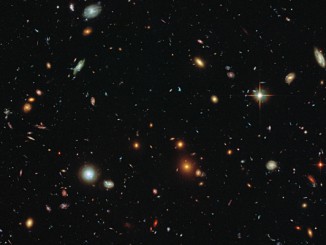
Peering deep into the early universe, this picturesque parallel field observation from the NASA/ESA Hubble Space Telescope reveals thousands of colourful galaxies swimming in the inky blackness of space in the constellation Sculptor. This spectacular skyscape was captured during the study of the giant galaxy cluster Abell 2744, otherwise known as Pandora’s Box.