News

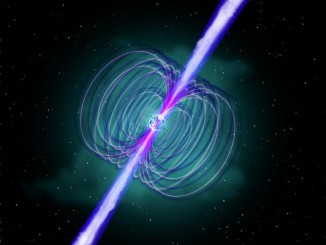
Super-luminous supernovae (SLSNe) are a relatively new and rare class of stellar explosions, 10 to 100 times brighter than normal supernovae. According to a new model, researchers have found that highly magnetised, rapidly spinning neutron stars called magnetars could explain the energy source behind SLSNe.
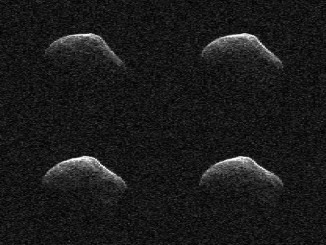
Astronomers were watching when comet P/2016 BA14 flew close by Earth on 22 March at a distance of slightly more than nine times the distance of the Moon. Radar images from the flyby indicate that the body is about a kilometre in diameter, while infrared spectra indicate that the comet’s nucleus is as dark as fresh asphalt.
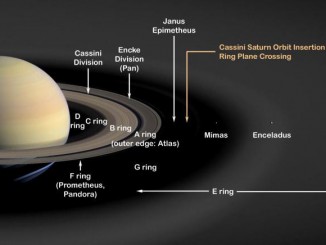
New research suggests that some of Saturn’s icy moons, as well as its famous rings, might be modern adornments. Their dramatic birth may have taken place a mere 100 million years ago. This would date the formation of the major moons of Saturn, with the exception of more distant Titan and Iapetus, to the relatively recent Cretaceous Period — the era of the dinosaurs.
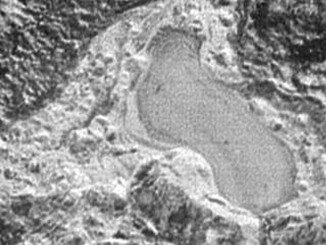
This feature appears to be a frozen, former lake of liquid nitrogen, located in a mountain range just north of Pluto’s informally named Sputnik Planum. Captured by the New Horizons’ Long Range Reconnaissance Imager (LORRI) as the spacecraft flew past Pluto on 14 July 2015, the image shows the possible lake to be about 20 miles (30 kilometres) across.
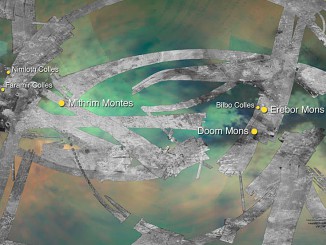
By convention, mountains on Saturn’s largest moon, Titan, are named for mountains from Middle-earth, the fictional setting in fantasy novels by J.R.R. Tolkien. Unfortunately for “Lord of the Rings” fans, Titan’s highest peak is not Doom Mons, but a trio of ridges known as Mithrim Montes, where the tallest peak is 10,948 feet (3,337 metres) high.
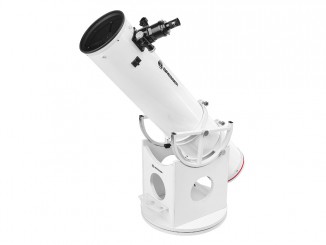
As its name suggests, this novel Dobsonian’s eight inch (203mm) aperture provides a light grasp suitable for exploring the galaxies and nebulae that constitute the Messier catalogue — yet its 1218mm focal length (f/6) gives it access to the higher magnifications required for planetary observations too, says reviewer Steve Ringwood.
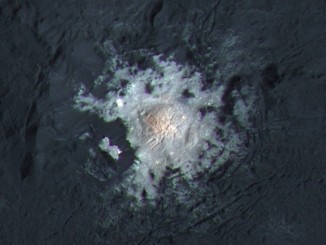
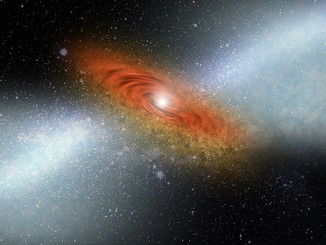
Galaxies reached their busiest star-making pace about 11 billion years ago, then slowed down. Scientists have puzzled for years over the question of what happened. Now researchers have found evidence supporting the argument that the answer was energy feedback from quasars within the galaxies where stars are born.
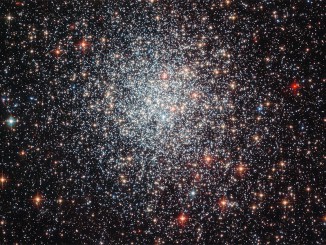
Researchers have developed a new conceptual framework for understanding how stars similar to our Sun evolve. Their framework helps explain how the rotation of stars, their emission of X-rays, and the intensity of their stellar winds vary with time. Their work could ultimately help to determine the age of stars more precisely than is currently possible.
© 2026 Nebula Press Ltd