Picture This

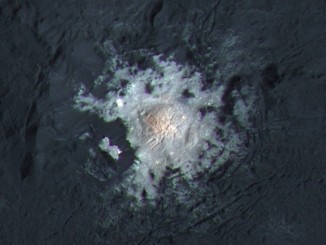
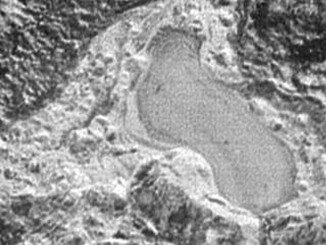
A pond of frozen nitrogen on Pluto

This feature appears to be a frozen, former lake of liquid nitrogen, located in a mountain range just north of Pluto’s informally named Sputnik Planum. Captured by the New Horizons’ Long Range Reconnaissance Imager (LORRI) as the spacecraft flew past Pluto on 14 July 2015, the image shows the possible lake to be about 20 miles (30 kilometres) across.
News

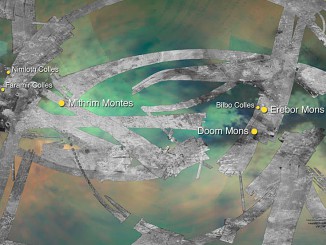
Cassini spies Titan’s tallest peaks

By convention, mountains on Saturn’s largest moon, Titan, are named for mountains from Middle-earth, the fictional setting in fantasy novels by J.R.R. Tolkien. Unfortunately for “Lord of the Rings” fans, Titan’s highest peak is not Doom Mons, but a trio of ridges known as Mithrim Montes, where the tallest peak is 10,948 feet (3,337 metres) high.

Equipment

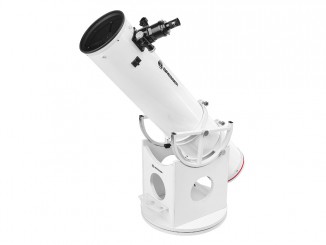
Bresser Messier 8-inch Dobsonian

As its name suggests, this novel Dobsonian’s eight inch (203mm) aperture provides a light grasp suitable for exploring the galaxies and nebulae that constitute the Messier catalogue — yet its 1218mm focal length (f/6) gives it access to the higher magnifications required for planetary observations too, says reviewer Steve Ringwood.

News

A new way to determine the age of stars?

Researchers have developed a new conceptual framework for understanding how stars similar to our Sun evolve. Their framework helps explain how the rotation of stars, their emission of X-rays, and the intensity of their stellar winds vary with time. Their work could ultimately help to determine the age of stars more precisely than is currently possible.

News

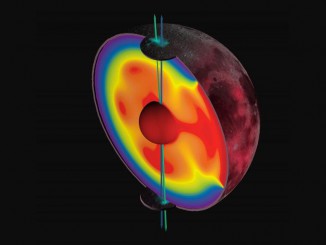
Ancient lunar polar ice reveals tilting of Moon’s axis

Did the “Man in the Moon” look different from ancient Earth? New NASA-funded research provides evidence that the spin axis of the Moon shifted by about five degrees roughly three billion years ago. The evidence of this motion is recorded in the distribution of ancient lunar ice, evidence of delivery of water to the early solar system.

Picture This

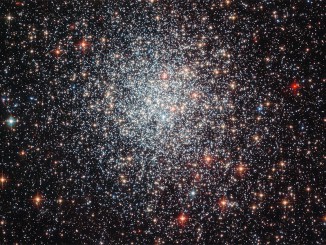
The wilds of the Local Group

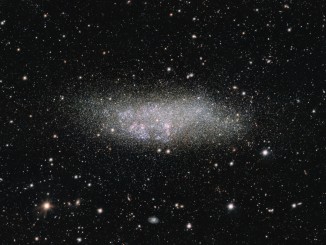
This image shows a lonely galaxy known as Wolf-Lundmark-Melotte, or WLM for short. Although considered part of our Local Group of dozens of galaxies, WLM stands alone at the group’s outer edges as one of its most remote members. In fact, WLM is so small and secluded that it may never have interacted with any other galaxy in the history of the universe.