News

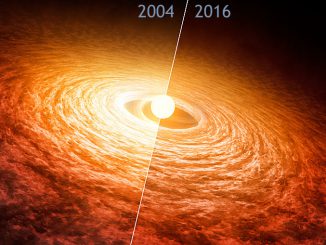
Gluttonous young star may hold clues to planet formation

In 1936, infant star FU Orionis began gobbling material from its surrounding disc of gas and dust with a sudden voraciousness, eating the equivalent of 18 Jupiters in the last 80 years. During a three-month binge, as matter turned into energy, the star became 100 times brighter, heating the disc around it to temperatures of up to 6,650 °C.

News

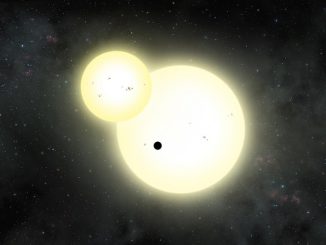
New planet Kepler-1647b is largest discovered that orbits two suns

If you cast your eyes toward the constellation Cygnus, you’ll be looking in the direction of the largest planet yet discovered with the widest orbit around a double-star system. It’s too faint to see with the naked eye, but a team led by astronomers from NASA’s Goddard Space Flight Center and San Diego State University used NASA’s Kepler Space Telescope to identify the new planet.

News

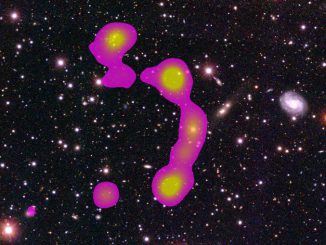
Extreme trans-Neptunian objects lead the way to Planet Nine

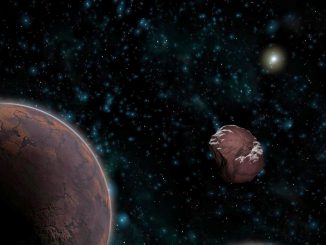
In the race towards the discovery of Planet Nine, scientists from around the world strive to calculate its orbit using the tracks left by the small bodies that move well beyond Neptune. Now, astronomers from Spain and Cambridge University have confirmed that the orbits of the six extreme trans-Neptunian objects that served as a reference to announce the existence of Planet Nine are not as stable as originally thought.

News

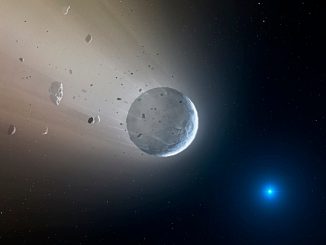
Understanding stellar adolescence through T-Tauri stars

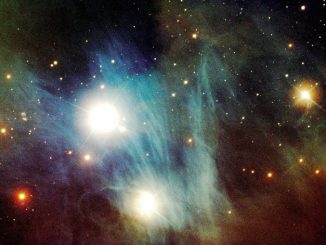
A newborn star typically goes through four stages of adolescence. It begins life as a protostar, accreting material and developing a proto-planetary disc. Slowly, stellar winds and radiation blow away the surrounding shell of gas and dust. Next, when the surrounding envelope has cleared, is called the T-Tauri phase. Finally, accretion stops and the source’s radiation comes from the star’s photosphere.

Picture This

Hubble captures scattered stars in Sagittarius

This colourful and star-studded view of the Milky Way galaxy was captured when the NASA/ESA Hubble Space Telescope pointed its cameras towards the constellation of Sagittarius. Blue stars can be seen scattered across the frame, set against a distant backdrop of red-hued cosmic companions. This blue litter most likely formed at the same time from the same collapsing molecular cloud.

Observing

See the Moon’s midnight rendezvous with Mars and Saturn

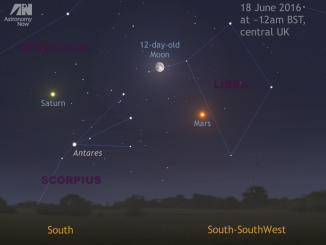
We may be losing Jupiter in the west at dusk, but two other planets are well placed in the late evening. Skywatchers in the UK and Western Europe should look low in the southern sky around 12am local time on 17, 18 and 19 June to see the waxing gibbous Moon in the vicinity of planets Mars and Saturn, plus first-magnitude star Antares in the constellation of Scorpius.