Picture This

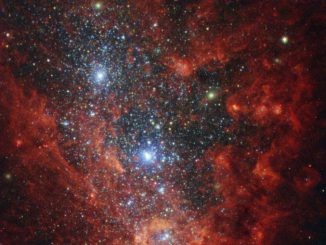
Hubble views the iridescent interior of a starburst galaxy

This NASA/ESA Hubble Space Telescope image reveals the glittering interior of one of the most active galaxies in our local neighbourhood — NGC 1569, a small starburst galaxy located about eleven million light-years away in the northern constellation of Camelopardalis. For almost 100 million years, NGC 1569 has pumped out stars over 100 times faster than the Milky Way.

Picture This

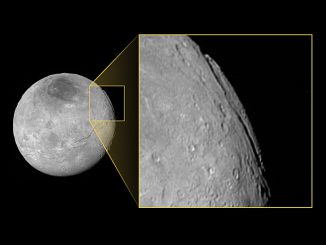
A ‘super Grand Canyon’ on Pluto’s moon Charon

Pluto’s largest moon, Charon, is home to an unusual canyon system that’s far longer and deeper than Arizona’s Grand Canyon. As far as NASA’s New Horizons scientists can tell, the canyon informally named Argo Chasma has a total length of approximately 430 miles — one and a half times the length and five times the depth of the Grand Canyon on Earth.

News

Hubble confirms new dark spot on Neptune

New images captured by the NASA/ESA Hubble Space Telescope (HST) confirm the presence of a dark vortex roughly 3,000 miles (4,800 kilometres) across in the atmosphere of Neptune. Though similar features were seen during the Voyager 2 flyby of Neptune in 1989 and by the HST in 1994, this vortex is the first one observed on Neptune in the 21st century.

Picture This

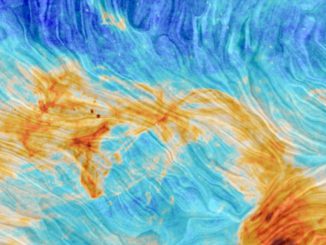
The spider in the loop

This multicoloured swirl of yellow and blue shows a prominent ring of gas near the North Celestial Pole. The pole appears to be fixed in place, while the rest of the night sky slowly circles around it because of Earth’s rotation. This image comes courtesy of ESA’s Planck satellite, which spent years mapping the entire sky in exquisite detail between 2009 and 2013.