Observing

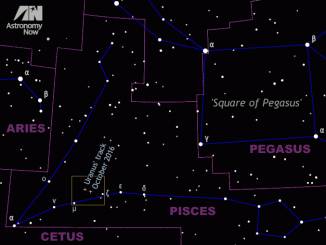
See planet Uranus at its best in the autumn sky

Have you ever seen Uranus with the naked eye? If not, moonless nights in October offer ideal conditions to test your visual acuity and sky clarity. Uranus reaches opposition on 15 October and attains a respectable altitude in the southern sky as seen from the British Isles. Here is our guide to tracking down the seventh planet from the Sun.

News

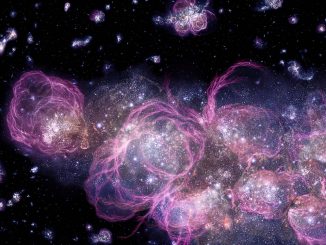
Using oxygen as a tracer of galactic evolution

A new study comprised of 7,000 galaxies casts light on how young, hot stars ionise oxygen in the early universe and the effects on the evolution of galaxies through time. The study presents the first measurements of the changing strengths of oxygen emission lines from the present day and back to 12.5 billion years ago.

Picture This

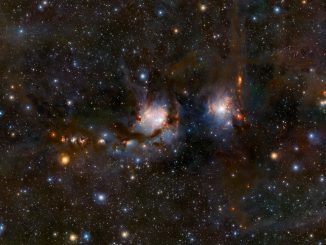
ESO’S VISTA telescope reveals hidden stars in Messier 78

In this new image of the nebula Messier 78, young stars cast a bluish pall over their surroundings, while red fledgling stars peer out from their cocoons of cosmic dust. ESO’s Visible and Infrared Survey Telescope for Astronomy (VISTA) sees near-infrared light, which passes right through dust, permitting astronomers to probe deep into the heart of the stellar environment.

News

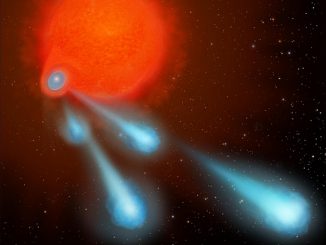
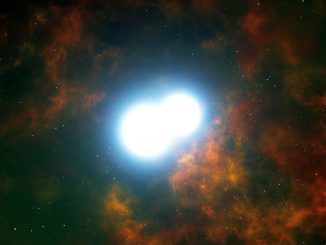
Detonating white dwarfs as supernovae

A new mathematical model created by astrophysicists at the American Museum of Natural History details a way that dead stars called white dwarfs could detonate, producing a type of explosion that is instrumental to measuring the extreme distances in our universe. The mechanism could improve our understanding of how Type Ia supernovae form.

News

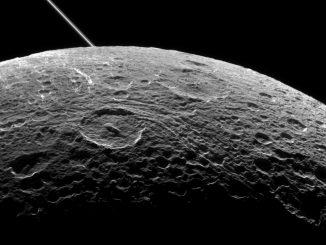
Saturn’s moon Dione harbours a subsurface ocean

A subsurface ocean lies deep within Saturn’s moon Dione, according to new data from the Cassini mission. Two other moons of Saturn, Titan and Enceladus, are already known to hide global oceans beneath their icy crusts. Researchers believe that Dione’s crust floats on an ocean several tens of kilometres deep located 100 kilometres below the surface.