News

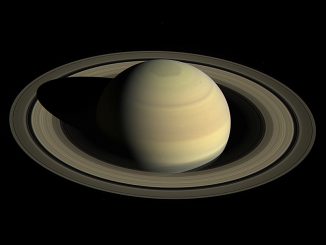
Saturn probe prepares for dramatic ring-grazing orbits

A thrilling ride is about to begin for NASA’s Cassini spacecraft. Engineers have been pumping up the probe’s orbit around Saturn this year to increase its tilt with respect to the planet’s equator and rings. And on 30 November, following a gravitational nudge from Saturn’s moon Titan, Cassini will enter the first phase of the mission’s dramatic endgame.
News

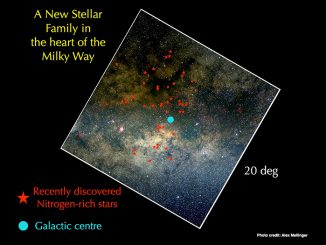
Spiral-like patterns of star formation discovered in old galaxies

Elliptical and Lenticular galaxies (historically referred to as early-type galaxies) are thought to be no longer giving birth to new stars. Now, a team led by astronomers from the Instituto de Astrofísica e Ciências do Espaço (IA) in Portugal has discovered optical spiral features in the outskirts of three nearby early-type galaxies, which points to a still ongoing inside-out growth.

Equipment

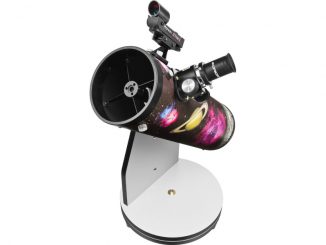
Orion Funscope Astro Dazzle 4.5” reflector kit

Steve Ringwood appraises the Orion Funscope Astro Dazzle, an eye-catching 4½-inch (114-mm) f/4.4 Newtonian reflector on a tabletop Dobsonian mount designed for beginners. The pre-assembled instrument possesses an inherent simplicity that will not challenge, with an aperture that brings a wealth of astronomy’s best to the viewer, he says.

News

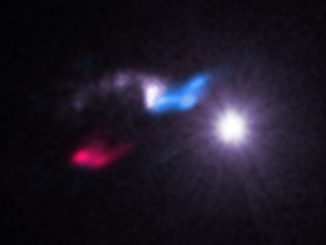
A stellar circle of life near Cygnus X-3

A discovery that provides a new way to study how stars form has been captured in a new portrait from NASA’s Chandra X-ray Observatory and the Smithsonian’s Submillimetre Array (SMA). A cloud that is giving birth to stars has been observed to reflect X-rays from Cygnus X-3, a source of X-rays produced by a system where a massive star is slowly being eaten by its companion black hole or neutron star.

News

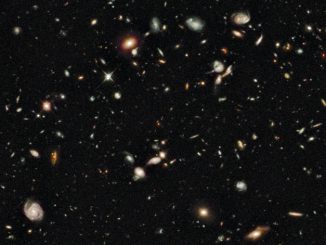
Forming stars in the early universe

The first stars appeared about 100 million years after the Big Bang. When the universe was about 3 billion years old, star formation activity peaked at rates about ten times above current levels. Why this happened, and whether the physical processes back then were different from those today, are among the most pressing questions in astronomy.

News

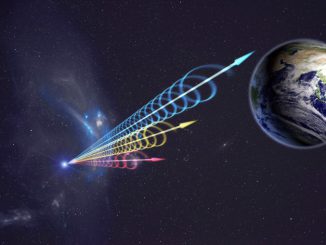
Mapping the cosmic web with fast radio bursts

Fast radio bursts, or FRBs, are mysterious flashes of radio waves originating outside our Milky Way galaxy. A team of scientists, jointly led by Caltech postdoctoral scholar Vikram Ravi and Curtin University research fellow Ryan Shannon, has now observed the most luminous FRB to date, called FRB 150807.

Picture This

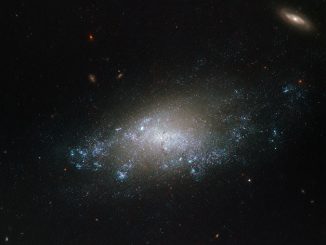
Hubble’s multispectral view of spiral galaxy NGC 3274

This image of the spiral galaxy NGC 3274 comes courtesy of the NASA/ESA Hubble Space Telescope’s Wide Field Camera 3 (WFC3). Hubble’s WFC3 vision spreads from the ultraviolet light through to the near infrared, allowing astronomers to study a wide range of targets, from nearby star formation through to galaxies in the most remote regions of the cosmos.

Picture This

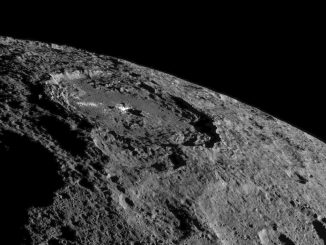
New views of dwarf planet Ceres as Dawn moves higher

The brightest area on Ceres stands out amid shadowy, cratered terrain in a dramatic new view from NASA’s Dawn spacecraft, taken as it looked off to the side of the dwarf planet. Dawn snapped this image from about 920 miles (1,480 kilometres) above Ceres in its fifth science orbit, in which the angle of the Sun was different from that in previous orbits.