Observing

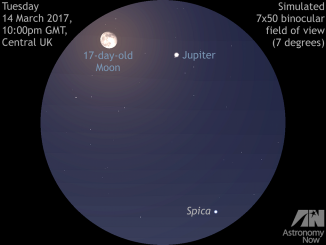
See the Moon and largest planet Jupiter get close on 14 March

Jupiter is now less than a month from opposition (7 April), so it’s very much open season for the Solar System’s largest planet. If you’re unsure where to find it, the rising 17-day-old waning gibbous Moon passes just two degrees from Jupiter on the UK evening of 14 March. Virgo’s brightest star, first-magnitude Spica, makes it a great binocular triumvirate.
News

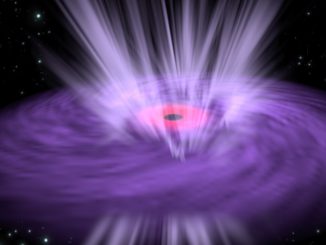
Hubble dates black hole’s last big meal

For the supermassive black hole at the center of our Milky Way galaxy, it’s been a long time between dinners. NASA’s Hubble Space Telescope has found that the black hole ate its last big meal about 6 million years ago, when it consumed a large clump of infalling gas.

Picture This

Voyager 1 sees Jupiter’s Great Red Spot

On 5 March 1979, Voyager 1 made its closest approach to Jupiter, passing at a distance of about 349,000 kilometres (217,000 miles) from the planet’s centre. It captured this close-up view of the swirling clouds around Jupiter’s Great Red Spot in February as it approached the gas giant.

Observing

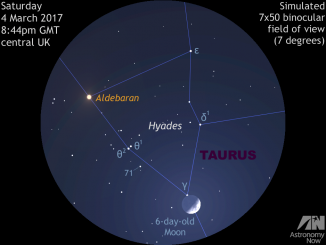
See the Moon glide through the Hyades on 4-5 March

On the night of 4-5 March 2017, UK observers with clear skies can see an occultation bonanza as the 6-day-old waxing crescent Moon passes in front of prominent members of the Hyades open cluster in Taurus. Some hours later, after the Moon has set in the British Isles, first-magnitude star Aldebaran is occulted across a large swathe of North America.

Picture This

Jovian cloudscapes

This close-up view of Jupiter from NASA’s Juno probe captures the turbulent region just west of the Great Red Spot in the South Equatorial Belt, with resolution better than any previous pictures from Earth or other spacecraft.

Picture This

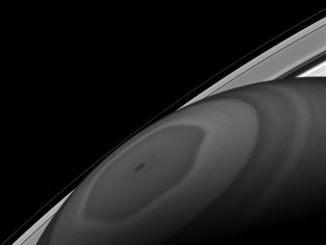
Saturn’s north pole

The north pole of Saturn sits at the center of its own domain. Around it swirl the clouds, driven by the fast winds of Saturn. Beyond that orbits Saturn’s retinue of moons and the countless small particles that form the ring.