News

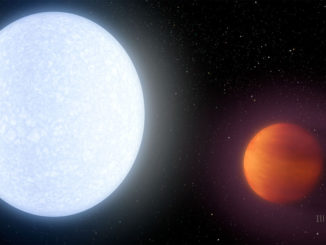
A newly discovered Jupiter-like world is so hot, it’s being vaporized by its own star. With a dayside temperature of more than 7,800 degrees Fahrenheit, KELT-9b is a planet that is hotter than most stars. But its blue A-type star, called KELT-9, is even hotter — in fact, it is probably unraveling the planet through evaporation.
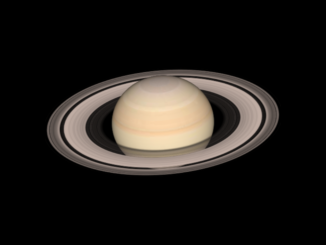
Skywatchers in the UK looking to the south-southeast shortly before midnight on Friday 9 June can see the rising full Moon just 2½ degrees above Saturn, the pair fitting comfortably in the same field of view of binoculars and telescopes magnifying less than 20×. Saturn is closest to the Earth for this year on 15 June, so here is our quick observing guide to the ringed planet at its best.

Three billion years ago, in a third of a second, two black holes crashed into each other and merged into a single entity, converting two solar masses into energy that shook the fabric of spacetime, sending gravitational ripples across the universe that were detected on Earth last January, researchers announced Thursday.
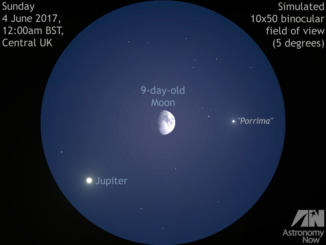
Jupiter now lies highest in the UK sky at sunset, but the Solar System’s largest planet and its four bright Galilean moons still provide plenty of observable events during June, as we reveal. If you’re uncertain which evening ‘star’ is Jupiter, the Moon conveniently passes by on the night of 3—4 June, a time when European skywatchers can also see the Moon occult (hide) bright double star Porrima.


Astronomers have discovered a new kind of galaxy in the early universe, less than a billion years after the Big Bang. These galaxies are forming stars more than a hundred times faster than our own Milky Way. The discovery could explain an earlier finding: a population of surprisingly massive galaxies at a time 1.5 billion years after the Big Bang, which would require such hyper-productive precursors to grow their hundreds of billions of stars.
© 2026 Nebula Press Ltd