Picture This

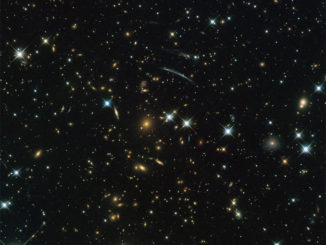
Galaxies like grains of sand, courtesy of Planck

The Hubble Space Telescope imaged a distant cluster of galaxies that was found by ESA’s Planck satellite, which detected distortions in the cosmic background radiation caused by the cluster’s gravity. Some five billion light years from Earth, the cluster’s members appear as a swarm of red-shifted galaxies, along with an arc of bluish light caused by gravitational lensing.
Picture This

A face-on spiral in all its glory – and colours

A composite image from the Hubble Space Telescope shows a dramatic range of color in galaxy NGC 3344, a weakly barred spiral half the size of the Milky Way some 20 million light years away in the constellation Leo Minor. Hot young stars, seen in blue, populate the spiral arms along with glowing red clouds of gas and dust that provide the raw materials for new suns.

Observing

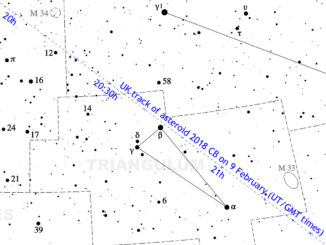
See asteroid 2018 CB’s close encounter on 9 February

As darkness falls over Western Europe on the evening of 9 February, near-Earth asteroid 2018 CB lies almost overhead as seen from the UK. We show you how and when to find this 30-metre-wide space rock as it speeds through the constellations of Perseus and Triangulum, passing just one-fifth of the Moon’s distance away at 22:27 UT (10:27pm GMT).