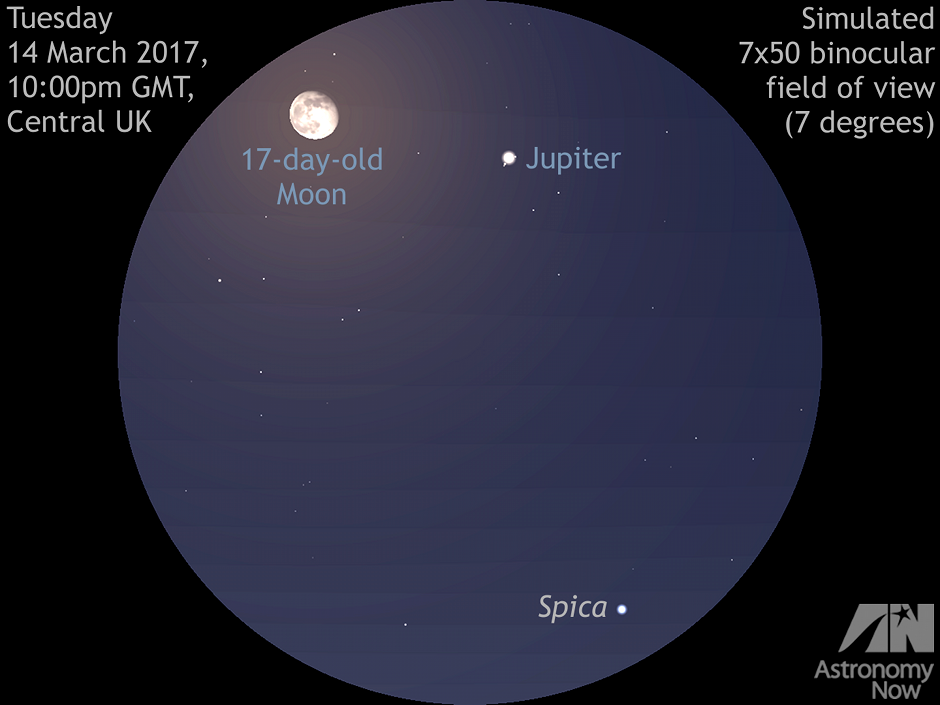
This simulated 7×50 binocular view shows the configuration of the rising 17-day-old waning gibbous Moon, largest planet Jupiter and first-magnitude star Spica in the constellation of Virgo at 10pm GMT on Tuesday 14 March 2017. The trio lie low in the east-southeast as seen from the British Isles at this time. AN graphic by Ade Ashford.If skies are clear on the night of Tuesday 14 March, look to the southeast around 10pm local time to see the 17-day-old Waning gibbous Moon in the same binocular view as planet Jupiter. As seen from the UK and Western Europe, the pair lie just 2 degrees apart. In low-power binoculars you’ll be able to fit first-magnitude star Spica — the primary luminary of the constellation Virgo — into the field of view too!
As viewed from the east coast of North America at 10pm local time, the Moon-Jupiter separation will have grown to 3.7 degrees, but the celestial triumvirate of Moon, planet and star will still make a beautiful grouping in low-power binoculars.
Jupiter is less than a month from opposition (7 April), so it’s very much open season for the Solar System’s largest planet. Now shining at magnitude -2.4, its mighty equator spans 43.3 arcseconds, meaning that a telescope magnifying just 42x is sufficient to enlarge it to the same apparent size of the adjacent Moon to the naked eye.
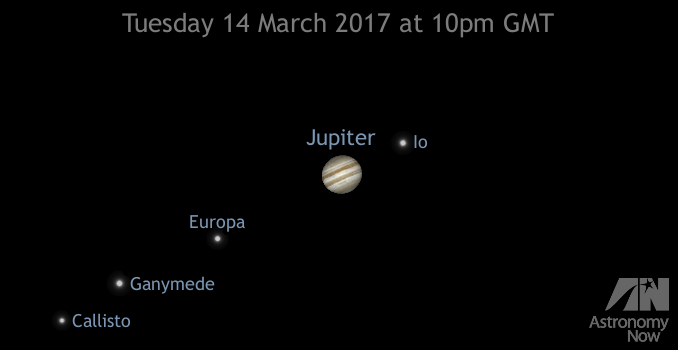
The apparent proximity of the Moon and Jupiter is, of course, a line of sight effect. The planet lies 423 million miles (681 million kilometres) from Earth on the night of 14 March — some 1,720 times farther away than the Moon.This computer simulation shows the configuration of Jupiter and its four large Galilean moons Io, Europa, Ganymede and Callisto at 10pm GMT on 14 March. This is an erect-image view (north up, east left) corresponding to a high-power binocular or terrestrial telescope. Users of Newtonian reflectors (including Dobsonians) need to rotate this view 180 degrees. Those using refractors and Schmidt- or Maksutov-Cassegrain telescopes with a star diagonal should mirror the image left-right to match their eyepiece views. AN graphic by Ade Ashford.If you have the clear skies and stamina to stay up in the UK, Jupiter’s Great Red Spot will be visible on the planet’s eastern limb by 2am GMT on 15 March and the GRS transits shortly after 3am GMT. The Great Red Spot will be close to Jupiter’s central meridian again at 11pm GMT on 15 March.
For predictions of GRS transits and phenomena of Jupiter’s Galilean moons Io, Europa, Ganymede and Callisto for other dates, times and locations, please consult our interactive online Almanac and ensure that the ‘Add phenomena of Jupiter?’ box is checked.
Inside the magazine
For a comprehensive guide to observing all that is happening in the coming month’s sky, tailored to Western Europe and North America, obtain a copy of the March 2017 edition of Astronomy Now.
A hundred days have passed since Mars was closest to Earth this year, but the Red Planet can still be seen in the early evening sky close to the jewel of the solar system, Saturn. If you wish to identify this pair of planets, then a convenient celestial marker in the form of the waxing crescent Moon passes by on the evenings of 8—9 September in the UK and Western Europe.
In the early evening of Tuesday, 23 February, the rising waning gibbous Moon — one day after full Moon — lies just 3½ degrees from magnitude -2.5 planet Jupiter low in the eastern sky. Jupiter is closest to Earth on Tuesday, 8 March, so now is the time to get acquainted with the solar system’s largest planet.
Early risers will already be aware that there’s currently a lot of planetary activity in the morning sky, but at dawn in Western Europe on Monday, 2 April, Mars and Saturn will be just 1¼ degrees apart and seen in the same field of view of telescopes at 30x magnification. The waning Moon is close by on the mornings of 7 & 8 April too.