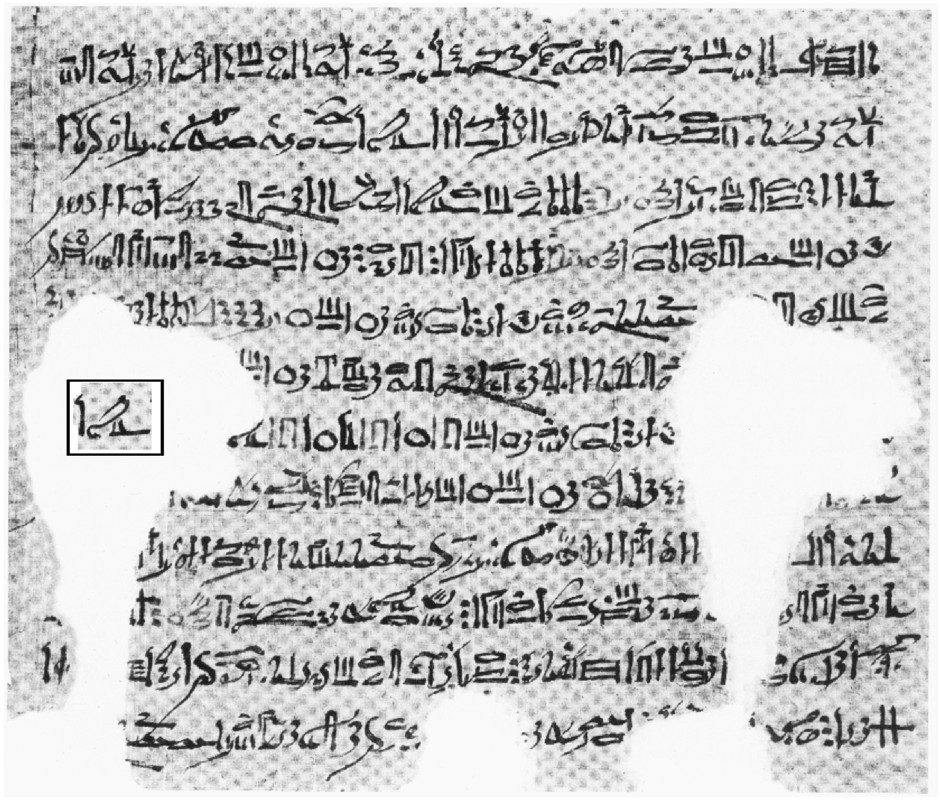
An extract of the Cairo Calendar papyrus (1244–1163 B.C.). The University of Helsinki scholars present evidence that the 2.85-day period in the Cairo Calendar is equal to that of the eclipsing binary Algol during this historical era. They show that Algol was represented as Horus and thus signified both divinity and kingship. The texts describing the actions of Horus are consistent with the course of events witnessed by a naked-eye observer of Algol, supporting the researchers claim that this document is the oldest preserved historical record of the discovery of a variable star. Inside the superimposed rectangle is the hieratic writing for the word ‘Horus’. Image credit: Lauri Jetsu.The Egyptian papyrus Cairo 86637 calendar is probably the oldest preserved historical document of naked-eye observations of the variability of Algol, or beta (β) Persei. Each day of one Egyptian year was divided into three parts in this calendar. A good or a bad prognosis was assigned for these parts of a day.
“The texts regarding the prognoses are connected to mythological and astronomical events,” says Master of Science Sebastian Porceddu.
A modern period analysis revealed that two statistically significant periods of 29.6 and 2.850 days have been recorded into the good prognoses. The former is clearly the period of the Moon. The second period differs slightly from the period Algol. In this eclipsing binary, the dimmer star partially covers the brighter star with a period of 2.867 days.
“These eclipses last about ten hours and they can be easily observed with unaided eyes. Their period was discovered by the British amateur astronomer John Goodricke in the year 1783,” says docent Lauri Jetsu.In Greek mythology, Perseus beheaded the Gorgon Medusa whose terrible gaze could turn anyone to stone. The eclipsing variable star Algol (from the Arabic Ra’s al-Ghul, meaning The Demon’s Head) is highlighted, the name suggesting that something unusual about the star was known from remote antiquity. Italian astronomer Geminiano Montanari noted Algol’s variability in 1667, but it was not until 1783 that British amateur astronomer John Goodricke correctly suggested its cause. AN graphic by Ade Ashford / Stellarium.“We can explain why the period of Algol has increased by about 0.017 days,” added Lauri Jetsu. “The period increase during the past three millennia could have been caused by the observed mass transfer between the two members of this binary. In fact, this would be the first observation that confirms the period increase of Algol and it also gives an estimate of the mass transfer rate.”
The ancient Egyptians have made accurate measurements that provide useful constraints for modern astronomers.
“It seems that the first observation of a variable star was made 3000 years earlier than was previously thought,” says Lauri Jetsu. “However, I want to emphasise that our research has only been sent to a scientific journal about two weeks ago. This type of results can raise a lot of controversy before they are accepted.”
The research was made in collaboration by the researchers from the Department of Physics and the Department of World Cultures of the University of Helsinki.
In recent nights, observers in the UK and Western Europe have seen the International Space Station (ISS) as a bright naked-eye ‘star’ moving slowly across the sky from west to east. On Thursday, 9 June, London is favoured for some close approaches of the ISS to the Moon, Jupiter and Saturn. If you see the Station, spare a thought for Tim Peake and the Expedition 47 crew on board!
The Israeli Beresheet lander, while braking into orbit around the Moon 4 April, beamed back stunning views of lunar farside, giving a hint of what to expect after landing 11 April.
Saturn’s summer apparition for 2015 is drawing to a close as the ringed planet is highest in the southern sky before sunset for observers in the British Isles, but it can still be found in the bright evening twilight if you have a convenient guide — like tonight’s gibbous Moon.