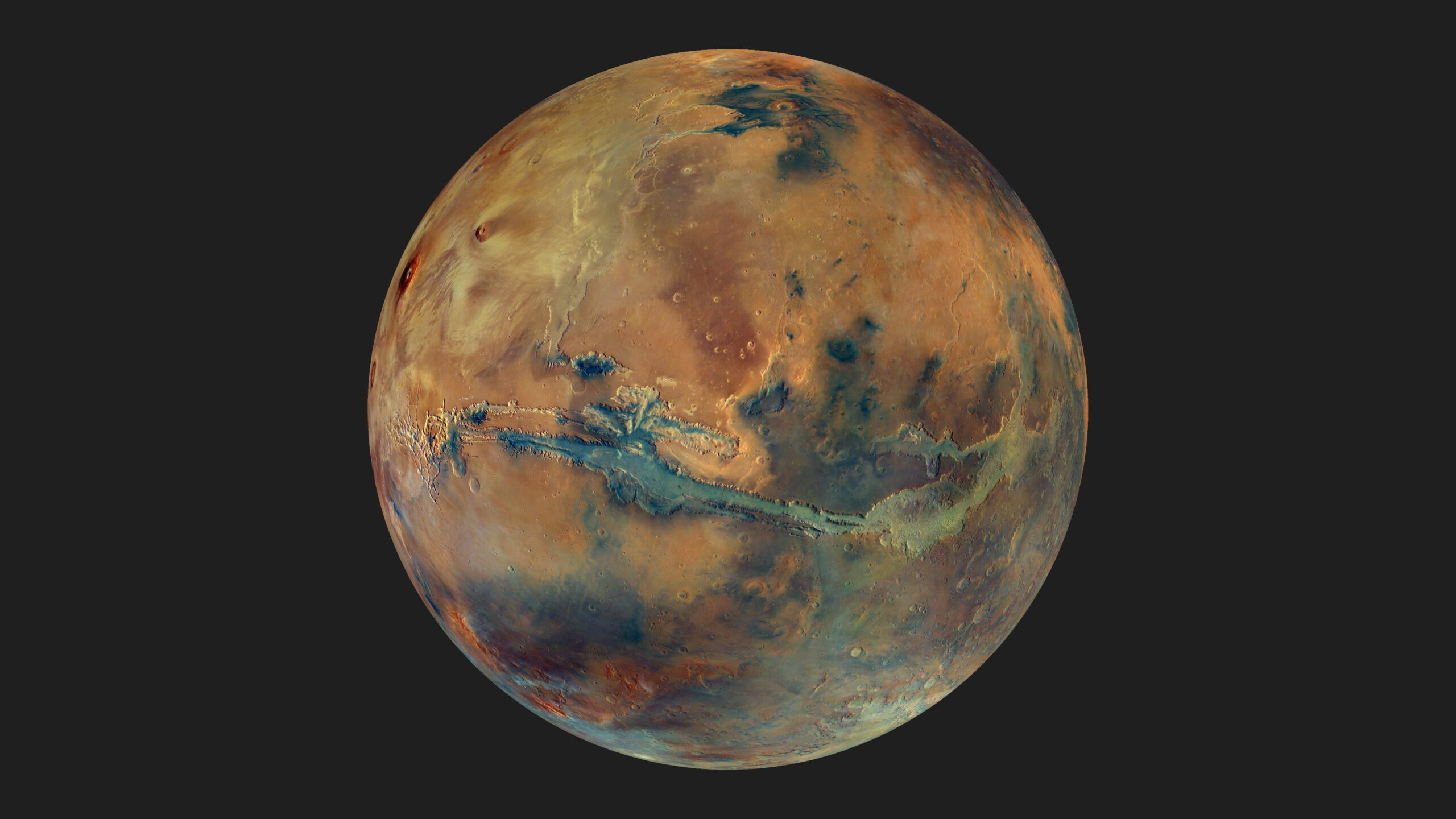
Mars is celebrating New Year on 30 September. There are no fireworks, no champagne and (as far as we know) no Martians singing ‘Auld Lang Syne’. But there is a surprisingly good story behind why the Red Planet is only turning 39.
Just like Earth, Mars has days, seasons and years. The trouble is that none of them quite matches ours. A Martian year lasts 687 Earth days, almost twice as long as a year on Earth. That means Martian New Year’s Day keeps moving around our calendar. The last one fell on 12 November 2024, this one is on 30 September 2026 and you will have to wait until 17 August 2028 to celebrate Mars Year 40.
Just like on Earth, New Year on Mars is tied to the planet’s seasons. On Earth, the date falls close to the shortest day in our northern hemisphere, known as the winter solstice. On Mars, astronomers have chosen the northern spring equinox, when day and night are more or less equal, as the moment when a new year begins. It is the Martian equivalent of the beginning of spring in Earth’s northern hemisphere.
Scientists studying Mars needed a simple way of keeping track of observations made during different Martian years. So they adopted a numbering system that begins with the Martian spring equinox of 11 April 1955. That became the first day of Mars Year 1.
It is a completely arbitrary choice that places a huge dust storm that engulfed much of the planet in 1956 during Mars Year 1. The calendar has since been extended backwards for anyone who needs to date earlier observations, a bit like our BC or BCE dates on Earth. In the case of Mars, however, the year before Year 1 is Year 0, followed by Year −1, Year −2 and so on.
The calendar has since been extended backwards as far as Mars Year −183, taking us all the way back to 1610, when Galileo became the first person to point a telescope at Mars.
And Martian time gets stranger.
A day on Mars is tantalisingly close to an Earth day, but not quite. Known as a ‘sol’, it lasts about 24 hours and 39 minutes. Forty extra minutes does not sound like much, but try adding them to your day every single day.
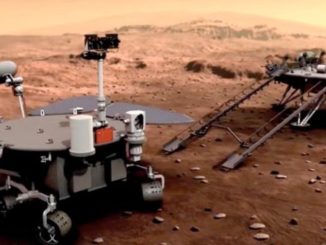
That is exactly what some of the people operating NASA’s Mars rovers have done. The practice goes back to the Pathfinder mission and its little Sojourner rover in 1997, and was later adopted by teams operating Spirit and Opportunity, Curiosity and Perseverance. During the busiest early stages of these missions, teams lived according to the rover’s clock on Mars. If the working day began at 9am one day, the next it began at roughly 9.40am, then 10.20am, and so on.
Things became particularly confusing when the twin Spirit and Opportunity rovers landed on almost opposite sides of Mars in 2004. Their operations teams were both living on Mars time, but roughly 12 hours apart from each other. One JPL scientist, John Callas, initially tried working with both teams, sleeping in his office between shifts, but lasted only a couple of days. ‘This is impossible for a human to do,’ he recalled in NASA’s On a Mission podcast.
Even sticking to one rover could leave people thoroughly out of step with life on Earth. After a week on Mars time you are more than four and a half hours adrift from everyone around you. Before long, you are eating breakfast while everyone else is thinking about going to bed. Also speaking on NASA’s On a mission podcast, NASA rover driver Vandi Verma recalled that teams even tried to avoid sunlight when their Martian body clocks said it should be night.
‘If you see the Sun and it’s supposed to be night time for you, it’s very disorienting,’ she said.
Perhaps the prize for truly embracing Martian life, however, belongs to NASA flight director David Oh and his family. When the Curiosity rover landed on Mars in 2012, they switched their whole household onto Mars time for a month.
Their days moved almost 40 minutes later every night, sending the family slowly around the clock. They ate meals at increasingly peculiar hours and explored Los Angeles in the middle of the night while the rest of the city slept.
So enjoy New Year on Mars this 30 September. The good news is that, measured in Martian years, most of us can knock off roughly half our age.
Explore the latest Mars science in depth in your October issue of Astronomy Now, where we ask what really happened to the planet’s water, atmosphere and potentially habitable environments.