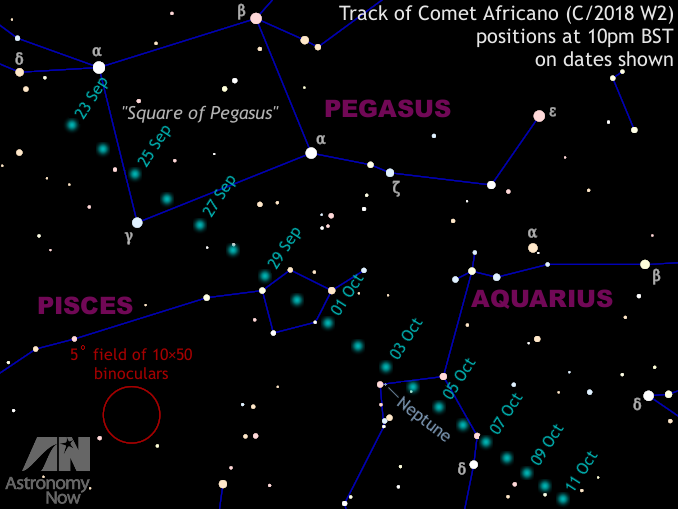
C/2018 W2 (Africano) is the brightest comet currently on show, passing closest to Earth on the morning of 27 September when it lies slightly less than half an astronomical unit or 74 million kilometres distant. By the end of the month, C/2018 W2 could attain magnitude +8.5 making it a viable target for small telescopes and larger binoculars under dark, moonless skies. This graphic represents the southeast aspect of the sky around 10pm local time in Western Europe, showing a portion of sky about 60 degrees wide (three times the span of an outstretched hand at arm’s length), with stars down to the naked-eye limit. The “Square of Pegasus” asterism is your eye-catching starting point. Note that on the night of 3–4 October, Comet Africano lies within a binocular field of view of outermost planet Neptune. AN graphic by Ade Ashford.Now that the Moon is a waning crescent rising after midnight, observers in the British Isles can take advantage of at least three hours of darkness from 9pm BST to track down Comet Africano (C/2018 W2) at its closest and brightest as it speeds through the constellations of Pegasus, Pisces and Aquarius.
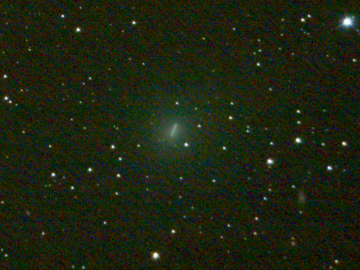
The 46-arcsecond drift of Comet Africano (C/2018 W2) against the stars of Andromeda is evident in this 6½ minute exposure captured, somewhat appropriately, with a vintage Celestron Comet Catcher on the night of 19 September 2019 at 20:20 UT. Image credit: Ade Ashford.At 10:56 UT on 27 September, C/2018 W2 (Africano) passes just 0.494 astronomical units, or 74 million kilometres (46 million miles) from Earth. At this time the comet is moving against the stars of Pegasus at a rate of 3⅔ degrees per day, equivalent to the width of the full Moon every 3¼ hours.
Discovered almost simultaneously on 27 November 2018 by B. M. Africano with the Mount Lemmon 1.5-metre reflector and H. Groeller with the Catalina Sky Survey’s 0.68-metre Schmidt telescope (Africano’s report was submitted just 21 minutes earlier), C/2018 W2’s integrated magnitude is currently about +9 and may peak at about +8.5 over the coming week. Note that Comet Africano lies within a binocular field of view of outermost planet Neptune on the night of 3–4 October.
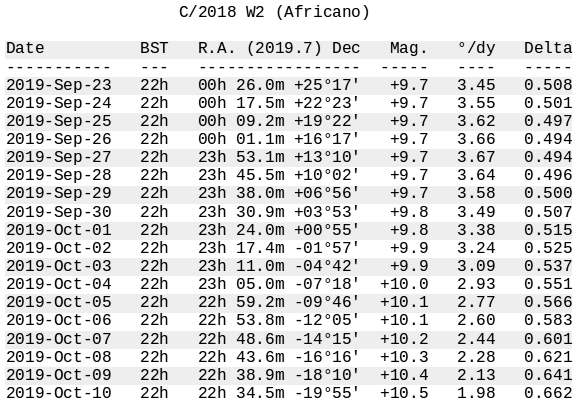
Having passed perihelion (closest point to the Sun) on 5 September, don’t miss any opportunities to view C/2018 W2 because it’s visiting the inner planets on a hyperbolic trajectory, meaning that it will never return to the Sun – unless its orbit is perturbed by the gravitational influence of a body in the outer Solar System in the distant future.This topocentric ephemeris of Comet Africano (C/2018 W2) is computed for the centre of the British Isles (54°N, 2.5°W) at 21h UT (10pm BST) on the dates shown. The comet’s right ascension (R.A.) and declination (Dec.) are for the current (J2019.7) epoch; Mag. is the total predicted (conservative?) visual magnitude; °/dy is the comet’s daily motion in degrees; Delta is the distance from Earth in astronomical units. AN computation and graphic by Ade Ashford/JPL’s HORIZONS system/Minor Planet Ephemeris Service.
Have you ever seen planet Uranus? If skies are clear in the UK and Western Europe on the evening of Sunday, 10 February, see this icy gas giant less than 2 degrees (or four lunar diameters) from Mars and 6 degrees from the 5-day-old crescent Moon. In fact, you’ll see all three in a single view of wide-angle binoculars like 7×50s.
More than 100 confirmed exoplanets — the biggest haul of worlds uncovered by the stabilised and repurposed Kepler space telescope in its K2 mission — is reported by an international science team led by the University of Arizona. Excitingly, the new population includes many worlds that could be rocky and cool enough to potentially support life.
Clear nights of early Northern Hemisphere autumn offer ideal opportunities to track down the two outermost planets of the solar system, Uranus and Neptune. What’s more, you don’t need a big telescope to find them. We show you how to locate these gas giants using binoculars. The Moon also passes close to Neptune on 20 October.