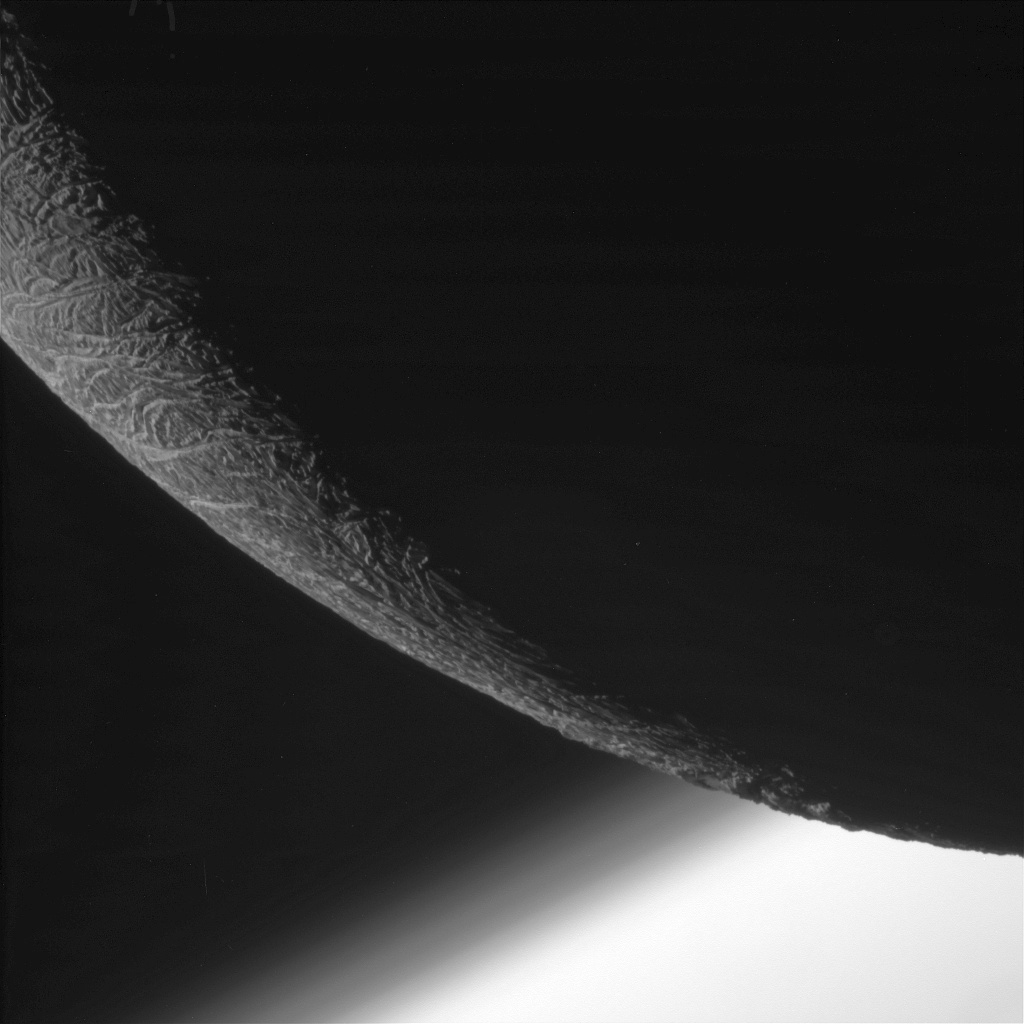
NASA’s Cassini spacecraft paused during its final close flyby of Enceladus to focus on the icy moon’s craggy, dimly lit limb, with the planet Saturn beyond. Layers can be seen in the high hazes of Saturn’s upper atmosphere, in the gradient that separates the planet from space. North on Enceladus is up and rotated 27 degrees to the left. The image was taken with the Cassini spacecraft narrow-angle camera on 19 December 2015, using a spectral filter, which preferentially admits wavelengths of near-infrared light. The view was acquired at a distance of approximately 15,000 miles (24,000 kilometres) from Enceladus. Image scale is 479 feet (146 metres) per pixel. Image credit: NASA/JPL-Caltech/Space Science Institute.NASA’s Cassini spacecraft has begun transmitting data and images from the mission’s final close flyby of Saturn’s active moon Enceladus. Cassini passed Enceladus at a distance of 3,106 miles (4,999 kilometres) on Saturday, 19 December at 5:49pm GMT (12:49pm EST).
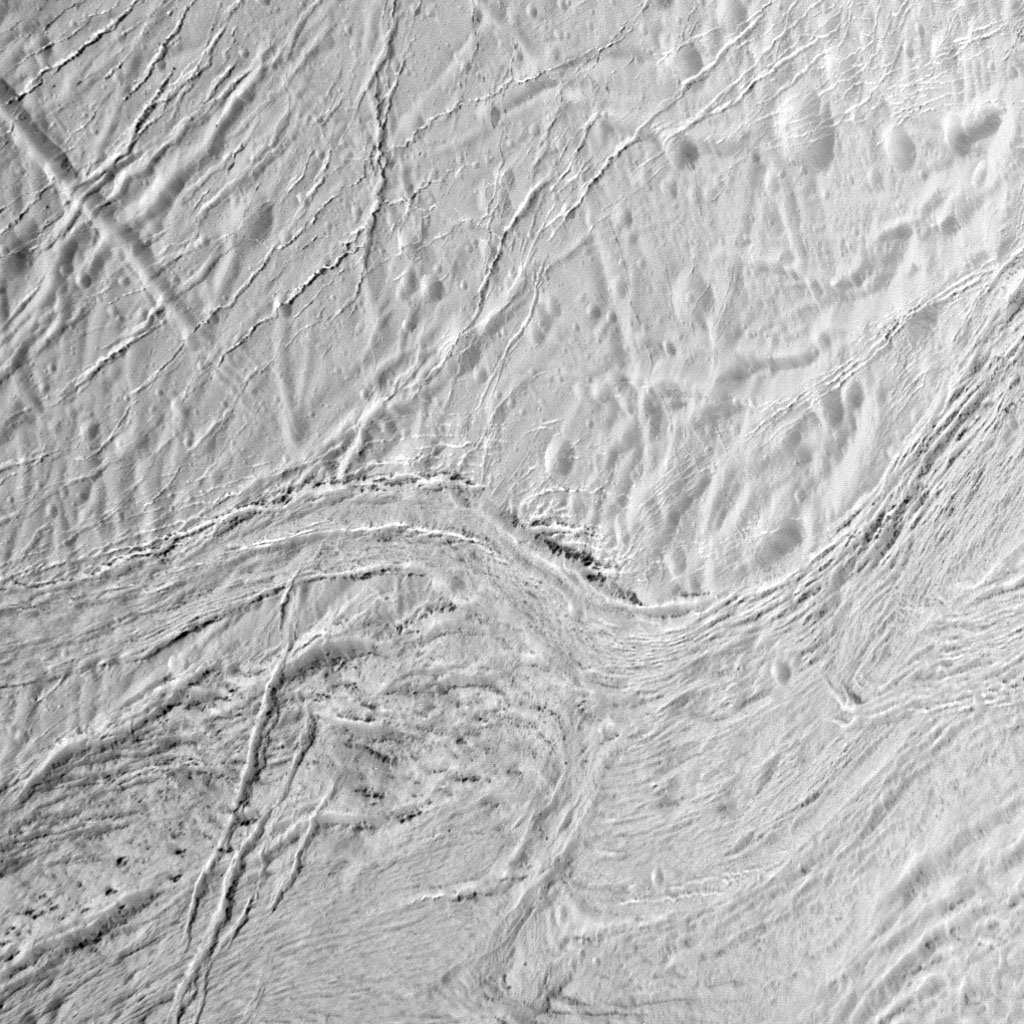
“This final Enceladus flyby elicits feelings of both sadness and triumph,” said Earl Maize, Cassini project manager at JPL. “While we’re sad to have the close flybys behind us, we’ve placed the capstone on an incredible decade of investigating one of the most intriguing bodies in the solar system.”During its final close flyby of Saturn’s moon Enceladus, NASA’s Cassini spacecraft captured this view featuring the nearly parallel furrows and ridges of the feature named Samarkand Sulci. This view is centered on terrain at 13 degrees north latitude, 336 degrees west longitude. The image was taken with the Cassini spacecraft narrow-angle camera on 19 December 2015, using a spectral filter, which preferentially admits wavelengths of near-ultraviolet light. The view was acquired at a distance of approximately 8,000 miles (12,000 kilometres) from Enceladus. Image scale is 243 feet (74 metres) per pixel. Image credit: NASA/JPL-Caltech/Space Science Institute.Cassini will continue to monitor activity on Enceladus from a distance, through the end of its mission in September 2017. Future encounters will be much farther away — at closest, more than four times farther than this latest encounter.
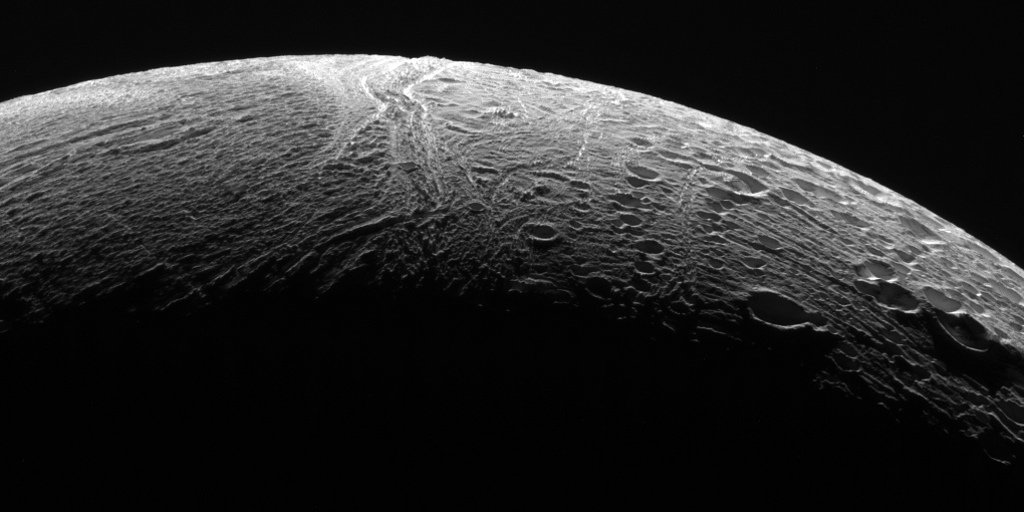
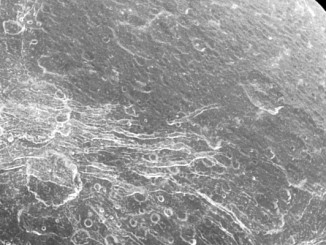
This was the 22nd Enceladus encounter of Cassini’s mission. The spacecraft’s discovery of geologic activity there, not long after arriving at Saturn, prompted changes to the mission’s flight plan to maximise the number and quality of flybys of the icy moon.NASA’s Cassini spacecraft peered out over the northern territory on Saturn’s moon Enceladus, capturing this view of two different terrain types. A region of older terrain covered in craters that have been modified by geological processes is seen at right, while at left is a province of relatively craterless, and presumably more youthful, wrinkled terrain. Cassini acquired the view during its final close flyby of Enceladus, on 19 December 2015. North on Enceladus is up and rotated 38 degrees to the left. The image was taken in polarised green light with the Cassini spacecraft narrow-angle camera. The view was acquired at a distance of approximately 21,000 miles (34,000 kilometres) from Enceladus. Image scale is 668 feet (204 metres) per pixel. Image credit: NASA/JPL-Caltech/Space Science Institute.“We bid a poignant goodbye to our close views of this amazing icy world,” said Linda Spilker, the mission’s project scientist at NASA’s Jet Propulsion Laboratory in Pasadena, California. “Cassini has made so many breathtaking discoveries about Enceladus, yet so much more remains to be done to answer that pivotal question, ‘Does this tiny ocean world harbour life?'”
After revealing Enceladus’ surprising geologic activity in 2005, Cassini made a series of discoveries about the material gushing from warm fractures near its south pole. Scientists announced strong evidence for a regional subsurface sea in 2014, revising their understanding in 2015 to confirm that the moon hosts a global ocean beneath its icy crust.
As avid skywatchers will already know, all of the bright naked-eye planets are currently visible in the pre-dawn sky — the first time in eleven years that such an alignment has occurred. At 6am GMT on Monday, 1 February, the last quarter Moon in the constellation Libra lies just 2½ degrees from magnitude +0.8 planet Mars low in the south for UK observers.
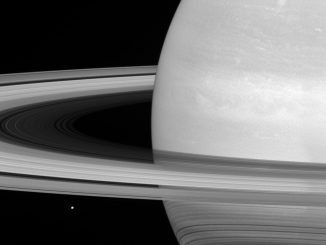
Saturn’s icy 246-mile-wide moon Mimas (near lower left) appears tiny by comparison to the planet’s rings, but scientists think the all of the small, icy particles spread over a vast area that comprise the rings are no more than a few times as massive as Mimas. The view was obtained by NASA’s Cassini spacecraft at a distance of approximately 564,000 miles from Saturn.
While not bursting with activity like its sister moon Enceladus, the surface of Saturn’s moon Dione is definitely not boring. Some parts of the surface are covered by linear features, called chasmata — bright icy cliffs among myriad fractures — which provide dramatic contrast to the round impact craters that typically cover moons.