
19 September 2026
Astronomy Now
  • Home
  • The Magazine
    • About
    • Current Issue
    • Subscribe
    • Renew Subscription
  • AstroFest 2026
  • News
  • Observing
    • UK Sky Chart
    • Almanac
    • Scope Calc
    • DSLR Calc
  • Reviews
    • Equipment
    • Book Reviews
  • Spaceflight Now
  • Shop
  • Contact Us
    • Subscriptions
    • Your Views
    • Ask Astronomy Now
    • Editorial
    • Advertising
    • AstroListings
Latest News
  • [ 8 September 2026 ] 3I/ATLAS was born in the deep freeze News
  • [ 30 August 2026 ] Roman Space Telescope launches on mission to survey the Universe News
  • [ 24 August 2026 ] JWST’s ‘impossible’ early galaxies may be even more massive than we thought News
  • [ 7 August 2026 ] How to observe the 12 August 2026 solar eclipse Eclipse
  • [ 5 August 2026 ] Falcon 9 lunar impact: More than a new crater News
  • Facebook
  • Twitter
  • LinkedIn

red dwarfs

News

Low-mass star simulations favour water-rich, Earth-sized planets

24 October 2016 Astronomy Now

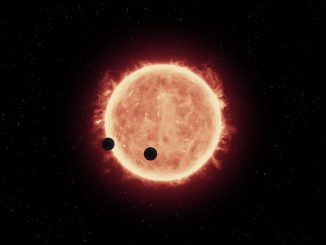
Astrophysicists at the University of Bern conducting computer simulations of the formation of planets orbiting in the habitable zone of low-mass stars, such as the red dwarf Proxima Centauri, show that these planets are most likely to be roughly the size of the Earth and to contain large amounts of water.
News

Stifling atmospheres could limit number of habitable exoplanets

26 May 2016 Astronomy Now

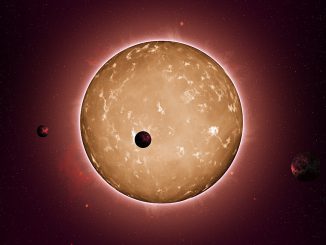
New research reveals that fewer than predicted planets may be capable of harbouring life because their atmospheres keep them too hot. Computer simulations show that planets similar to or larger in mass than the Earth that are born with thick envelopes of hydrogen and helium are likely to retain their stifling atmospheres.

News

Dust discs of nearby red dwarfs could reveal planetary secrets

16 September 2015 Astronomy Now

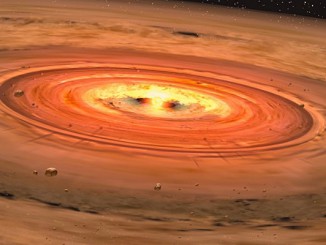
An accidental find of a collection of young red dwarf stars close to our solar system could give us a rare glimpse of slow-motion planet formation. Astronomers from The Australian National University and University of New South Wales, Canberra found large discs of dust around two of the stars, telltale signs of planets in the process of forming.

Latest Issue

Astronomy Now Newsletter

Get the wonders of the Universe delivered to your inbox. Sign up before 24 September for a 10% discount code for your Stargazer's Guide 2027!
* indicates required
Which elements of Astronomy interest you?

News Headlines

  • 3I/ATLAS was born in the deep freeze
    8 September 2026
  • Roman Space Telescope launches on mission to survey the Universe
    30 August 2026
  • JWST’s ‘impossible’ early galaxies may be even more massive than we thought
    24 August 2026
  • How to observe the 12 August 2026 solar eclipse
    7 August 2026
  • Falcon 9 lunar impact: More than a new crater
    5 August 2026

© 2026 Nebula Press Ltd

Astronomy Now