News

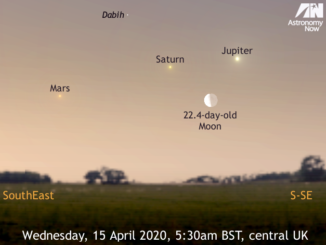
There’s a lot of planetary activity in the dawn sky in mid-April. If you’re an early riser in the British Isles, let the waning crescent Moon be your guide to the naked-eye planets Jupiter, Saturn and Mars on 15 and 16 April 2020. Typical 7×50 or 10×50 binoculars will show these attractive conjunctions well, while the smallest of telescopes also reveal some of Jupiter’s bright Galilean moons.



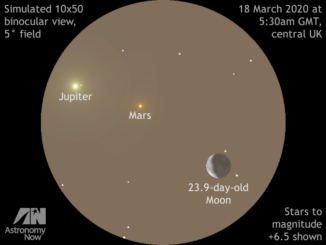
If you’re an early riser in the British Isles, let the waning crescent Moon be your guide to three naked-eye planets – Mars, Jupiter and Saturn – at dawn on 18 and 19 March 2020. This celestial conjunction occurs in the constellation of Sagittarius where you can see all four Solar System bodies within the span of a fist at arm’s length. Look for attractive binocular conjunctions too.

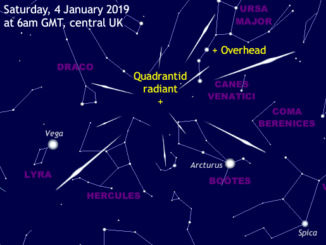
For an early astronomical treat to usher in the New Year, seek out the natural pyrotechnics of the rich Quadrantid meteor shower. Peak shooting star activity occurs within a four-hour window centred on a prediction of 8am GMT on 4 January 2020 – a time that favours UK skywatchers at astronomical dawn, or North American observers around local midnight.
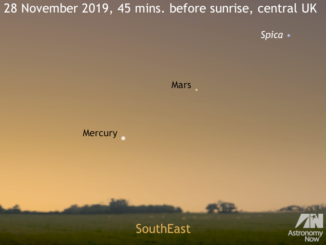
Innermost planet Mercury puts on its best morning display of the year for Northern Hemisphere observers from late November to early December. Skywatchers in the British Isles should find a location offering an unobstructed view of the southeast horizon about 45 minutes before sunrise to get the best views, with the Red Planet and star Spica – the brightest in Virgo – also nearby.
© 2026 Nebula Press Ltd