
13 August 2026
Astronomy Now
  • Home
  • The Magazine
    • About
    • Current Issue
    • Subscribe
    • Renew Subscription
  • AstroFest 2026
  • News
  • Observing
    • UK Sky Chart
    • Almanac
    • Scope Calc
    • DSLR Calc
  • Reviews
    • Equipment
    • Book Reviews
  • Spaceflight Now
  • Shop
  • Contact Us
    • Subscriptions
    • Your Views
    • Ask Astronomy Now
    • Editorial
    • Advertising
    • AstroListings
Latest News
  • [ 7 August 2026 ] How to observe the 12 August 2026 solar eclipse Eclipse
  • [ 5 August 2026 ] Falcon 9 lunar impact: More than a new crater News
  • [ 25 July 2026 ] Euclid opens a new window on the first billion years of cosmic history News
  • [ 10 June 2026 ] Caught in the act: the wind that could kill a galaxy News
  • [ 4 June 2026 ] Europe’s Mars rover may land in the remains of a vast ancient water system News
  • Facebook
  • Twitter
  • LinkedIn

1983 TB

Observing

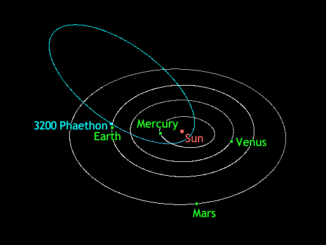
See asteroid Phaethon, source of the Geminids, in a close brush with Earth

4 December 2017 Ade Ashford

As shooting-star devotees prepare for the naked-eye spectacle of the Geminid meteor shower in mid-December, owners of small telescopes can also witness the close passage of the meteors’ parent body — a curious “rock comet” known as 3200 Phaethon, galloping through the constellations of Auriga, Perseus, Andromeda, Pisces and Pegasus at a rate of up to 15 degrees/day.
News

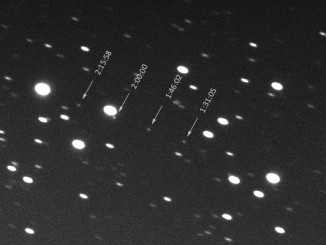
Astronomers recall discovery of Phaethon — source of Geminid meteors

12 December 2015 Astronomy Now

The beautiful Geminid meteor shower is due to light up the heavens this weekend, but the source of the enigmatic cosmic display had eluded stargazers for more than 120 years. Then, in 1983, two University of Leicester astronomers — Dr. Simon Green and Dr. John Davies — used data from the IRAS satellite to discover 3200 Phaethon, an asteroid with a very unusual orbit.

Latest Issue

Astronomy Now Newsletter

Get the wonders of the Universe delivered to your inbox.
* indicates required
Which elements of Astronomy interest you?

News Headlines

  • How to observe the 12 August 2026 solar eclipse
    7 August 2026
  • Falcon 9 lunar impact: More than a new crater
    5 August 2026
  • Euclid opens a new window on the first billion years of cosmic history
    25 July 2026
  • Caught in the act: the wind that could kill a galaxy
    10 June 2026
  • Europe’s Mars rover may land in the remains of a vast ancient water system
    4 June 2026

© 2026 Nebula Press Ltd

Astronomy Now