Observing

See Mercury at its best meet Mars in the dawn sky

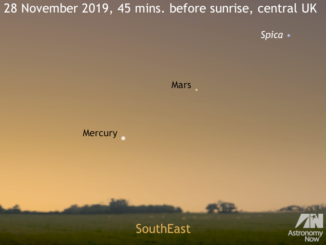
Innermost planet Mercury puts on its best morning display of the year for Northern Hemisphere observers from late November to early December. Skywatchers in the British Isles should find a location offering an unobstructed view of the southeast horizon about 45 minutes before sunrise to get the best views, with the Red Planet and star Spica – the brightest in Virgo – also nearby.

Observing

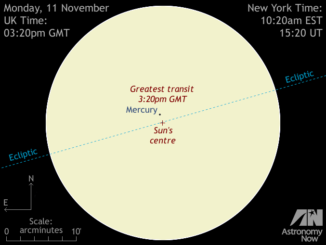
How to safely observe Mercury crossing the Sun on 11 November

On Monday, 11 November 2019 just after 12:30pm GMT, suitably equipped observers in the British Isles can witness the start of a 3.7-hour spectacle that hasn’t been seen for three-and-a-half years — the silhouette of innermost planet Mercury crossing the face of the Sun. Here’s our online guide to observing this fascinating and comparatively rare event in complete safety.

Observing

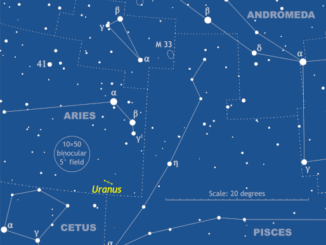
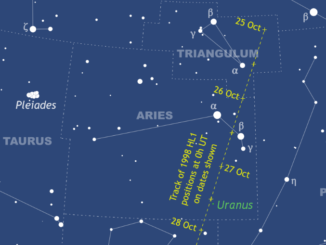
Observe planet Uranus at its best in the autumn sky

Have you ever seen Uranus with the naked eye? If not, moonless nights in late October and November offer ideal conditions to test your visual acuity and sky clarity. Uranus reaches opposition in the constellation of Aries on 28 October 2019 and lies 48° above the southern horizon at midnight as seen from the heart of the British Isles. Here is our guide to tracking down the seventh planet from the Sun.

Observing

See the waxing Moon meet the outermost planet on 10 October

The 12-day-old Moon lies in the same low-power binocular field as Neptune late into the evening of Thursday, 10 October 2019 when observers in the UK can find the pair highest in the southern sky against the constellation of Aquarius. The glare of the gibbous Moon will present a challenge, but well worth the attempt to find the outermost planet with modest optical aid.