
12 April 2026
Astronomy Now
  • Home
  • The Magazine
    • About
    • Current Issue
    • Subscribe
    • Renew Subscription
  • AstroFest 2026
  • News
  • Observing
    • UK Sky Chart
    • Almanac
    • Scope Calc
    • DSLR Calc
  • Reviews
    • Equipment
    • Book Reviews
  • Spaceflight Now
  • Shop
  • Contact Us
    • Subscriptions
    • Your Views
    • Ask Astronomy Now
    • Editorial
    • Advertising
    • AstroListings
Latest News
  • [ 11 April 2026 ] Dark matter may come in multiple forms, new model suggests News
  • [ 2 April 2026 ] Witness to history: Artemis II, lunar exploration and hope News
  • [ 25 March 2026 ] Artificial Intelligence uncovers more than 100 new worlds in NASA data News
  • [ 24 March 2026 ] XRISM solves gamma-Cas’s 50-year X-ray mystery News
  • [ 16 March 2026 ] Molten lava world points to new class of planet Focus on
  • Facebook
  • Twitter
  • LinkedIn

News

News

Europe’s Philae comet lander phones home

14 June 2015 Astronomy Now

The European Space Agency reports it has received signals from the Philae lander on the surface of comet 67P/Churyumov–Gerasimenko.

News

Hubble detects ‘sunscreen’ layer on distant exoplanet

13 June 2015 Astronomy Now

NASA’s Hubble Space Telescope has detected a stratosphere, one of the primary layers of Earth’s atmosphere, on a massive and blazing-hot exoplanet known as WASP-33b orbiting a star in Andromeda 380 light-years away.

News

The origins of an emerging bipolar planetary nebula revealed

12 June 2015 Astronomy Now

Astronomers have for the first time captured what appears to be the moment when a red giant star evolves into a stunning butterfly-like planetary nebula, using the SPHERE instrument on the European Southern Observatory’s Very Large Telescope (VLT).

News

Helium-shrouded planets may be common in our Galaxy

12 June 2015 Astronomy Now

Planets having atmospheres rich in helium may be common in our Galaxy, according to a new theory based on data from NASA’s Spitzer Space Telescope. These planets would be around the mass of Neptune, or lighter, and would orbit close to their stars, basking in their searing heat.

News

Chandra finds evidence for serial black hole eruptions in NGC 5813

11 June 2015 Astronomy Now

Astronomers have used NASA’s Chandra X-ray Observatory to show that multiple eruptions from a supermassive black hole over 50 million years have rearranged the cosmic landscape at the centre of a group of galaxies.

News

Volcanic outgassing to aid in the search for life on other planets

11 June 2015 Astronomy Now

Finding ways to confirm life on planets outside of our Solar System is often at the forefront of exoplanet research. Now a team of graduate students at the University of Washington (UW) have found a way to aid this search by proposing that future telescopes should look for explosive volcanic activity as a potential marker for life on other worlds.

News

UK work-experience schoolboy discovers a new planet

10 June 2015 Astronomy Now

Tom Wagg, now aged 17, discovered a new planet orbiting a star 1000 light-years away in the constellation of Hydra. He was doing work-experience at Keele University two years ago when he spotted the body by finding a tiny dip in the light of its parent star as the planet passed in front of it.

News

New model could track solar storms 24 hours before reaching Earth

10 June 2015 Astronomy Now

Our Sun is a volatile star, producing giant clouds of solar particles called coronal mass ejections. Now scientists may finally have a tool to predict the magnetic configuration of a CME from afar, enabling forecasters to give utility grid and satellite operators a day’s advance warning to protect their systems.
News

NASA spacecraft detects impact glass on surface of Mars

9 June 2015 Astronomy Now

NASA’s Mars Reconnaissance Orbiter (MRO) has detected deposits of glass within impact craters on Mars. Though formed in the searing heat of a violent impact, such deposits might provide a delicate window into the possibility of past life on the Red Planet.

News

ALMA’s detailed view of star formation in the distant universe

8 June 2015 Astronomy Now

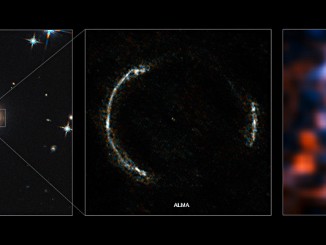
The Atacama Large Millimetre/submillimetre Array has produced a spectacularly detailed image of a distant galaxy known as SDP.81 that is being gravitationally lensed. The image shows a magnified view of the galaxy’s star-forming regions, the likes of which have never been seen before at this level of detail in a galaxy so remote.

Posts pagination

« 1 … 189 190 191 … 218 »

Latest Issue

Astronomy Now Newsletter

Join our mailing list.
* indicates required
Which elements of Astronomy interest you?

News Headlines

  • Dark matter may come in multiple forms, new model suggests
    11 April 2026
  • Witness to history: Artemis II, lunar exploration and hope
    2 April 2026
  • Artificial Intelligence uncovers more than 100 new worlds in NASA data
    25 March 2026
  • XRISM solves gamma-Cas’s 50-year X-ray mystery
    24 March 2026
  • Molten lava world points to new class of planet
    16 March 2026

© 2019 Pole Star Publications Limited

Astronomy Now