23 February 2026
Astronomy Now
  • Home
  • The Magazine
    • About
    • Current Issue
    • Subscribe
    • Renew Subscription
  • AstroFest 2026
  • News
  • Observing
    • UK Sky Chart
    • Almanac
    • Scope Calc
    • DSLR Calc
  • Reviews
    • Equipment
    • Book Reviews
  • Spaceflight Now
  • Shop
  • Contact Us
    • Subscriptions
    • Your Views
    • Ask Astronomy Now
    • Editorial
    • Advertising
    • AstroListings
Latest News
  • [ 26 January 2026 ] Dr Allan Chapman (1946-2026) News
  • [ 16 January 2026 ] Potentially bright ‘sungrazing’ comet discovered News
  • [ 17 December 2025 ] Thank you from the editor News
  • [ 25 October 2025 ] Hubble revisits a cosmic yardstick News
  • [ 21 October 2025 ] Europe’s planet hunting spacecraft complete and ready for final testing News
  • Facebook
  • Twitter
  • LinkedIn

News

News

Royal Astronomical Society’s National Astronomy Meeting 2015 – report 2

7 July 2015 Astronomy Now

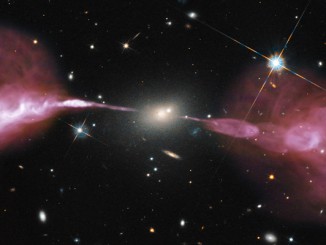
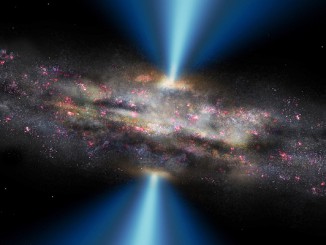
In his second report from the Royal Astronomical Society’s National Astronomy Meeting 2015, Kulvinder Singh Chadha ponders the nature of dark matter and whether cosmic jets — jets of material from active galaxies travelling close to the speed of light — may correlate with dense regions of dark matter in the Universe.
News

Royal Astronomical Society’s National Astronomy Meeting 2015 – report 1

6 July 2015 Astronomy Now

The Royal Astronomical Society’s National Astronomy Meeting 2015 in Llandudno, Wales, 5—9 July
is the largest regular professional astronomy event in the UK and will see leading researchers from around the world presenting the latest work in a variety of fields. Kulvinder Singh Chadha reports from the conference.
News

Stellar fireworks predicted during rare pulsar encounter in 2018

6 July 2015 Astronomy Now

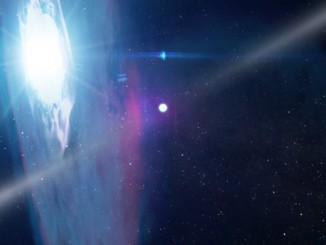
Astronomers are expecting high-energy explosions when pulsar J2032 swings close by its massive companion star in early 2018. The pulsar will plunge through a disc of gas and dust surrounding the star, triggering cosmic fireworks from radio wavelengths to the highest-energy gamma rays detectable.

News

Technical problem pauses Pluto probe’s science operations

5 July 2015 Stephen Clark

NASA’s New Horizons space probe, 10 days from a one-shot encounter with enigmatic Pluto, stopped collecting science data Saturday after a technical problem interrupted the spacecraft’s tightly-choreographed flight plan.

News

SOFIA in the right place at the right time for Pluto observations

4 July 2015 Astronomy Now

Currently operating out of Christchurch, New Zealand, the NASA/DLR SOFIA airborne 2.5-metre infrared telescope had to make last-minute flight path corrections to successfully secure observations of Pluto’s atmosphere as it occulted a distant star.

News

Dark matter map begins to reveal the universe’s early history

3 July 2015 Astronomy Now

Astronomers using the 870 million-pixel Hyper Suprime-Cam camera on the 8.2-metre Subaru telescope in Hawaii have begun a wide-area survey of the distribution of dark matter in the universe.

News

Two faces of Pluto revealed in colour imagery

2 July 2015 Stephen Clark

The first well-resolved colour photos of Pluto from NASA’s New Horizons spacecraft, speeding toward a close-up encounter July 14, show a world blotched with dark features spanning two very different sides of the dwarf planet.

News

Is the universe ringing like a crystal glass?

1 July 2015 Astronomy Now

Two physicists at the University of Southern Mississippi have discovered that the universe might not only be expanding, but also oscillating or “ringing” at the same time, something that has occurred seven times since its creation.

News

NASA explains why 30 June received an extra ‘leap second’

30 June 2015 Astronomy Now

Although we are unaware of it in our everyday lives, the Earth’s rotation is slowing down, so each mean solar day is about 0.002 seconds longer than the last. NASA explains why Tuesday, 30 June 2015, will have an extra second, or “leap” second, added.

News

Messier 87 has swallowed an entire galaxy in the last billion years

26 June 2015 Astronomy Now

M87 is a giant elliptical galaxy with a total mass more than a million million times that of the Sun that lies at the centre of the Virgo Cluster about 50 million light-years away. New observations with the European Southern Observatory’s Very Large Telescope have revealed the full extent of the galaxy’s cannibalistic nature.

Posts pagination

« 1 … 186 187 188 … 218 »

Astronomy Now NewsAlert

* indicates required
Which elements of Astronomy interest you?

News Headlines

  • Dr Allan Chapman (1946-2026)
    26 January 2026
  • Potentially bright ‘sungrazing’ comet discovered
    16 January 2026
  • Thank you from the editor
    17 December 2025
  • Hubble revisits a cosmic yardstick
    25 October 2025
  • Europe’s planet hunting spacecraft complete and ready for final testing
    21 October 2025

© 2019 Pole Star Publications Limited

Astronomy Now