News

Skull-shaped Halloween close fly-by object is likely a dead comet

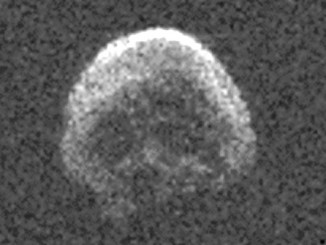
Somewhat appropriately spooky for Halloween in recent radar images, 600 metre-wide near-Earth object 2015 TB145 dashes by our planet today. Now believed to be a dead comet that has shed its volatiles after numerous passes around the Sun, the object makes its closest approach to Earth at 5pm GMT. UK observers with clear skies may see it with modest telescopes in the early evening.
Picture This

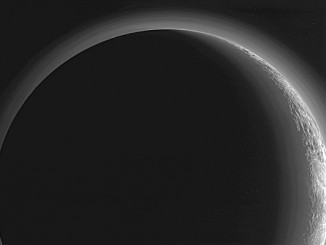
New Horizons returns full view of Pluto’s stunning crescent

In September, the New Horizons team released a stunning but incomplete image of Pluto’s crescent. Thanks to updated processing work by the science team, New Horizons is releasing the entire, breathtaking image of Pluto. The team also released images showing extended mapping of the dwarf planet’s “heart” feature and young craters on Pluto’s largest moon, Charon.

News

Q Continuum computer simulation models birth of universe

Researchers are sifting through an avalanche of data produced by one of the largest cosmological simulations ever performed. The simulation, run on the Titan supercomputer at the U.S. Department of Energy’s Oak Ridge National Laboratory, modelled the evolution of the universe from just 50 million years after the Big Bang to the present day.

News

Surprising discovery of molecular oxygen on comet 67P

ESA’s Rosetta spacecraft has made the first in situ detection of oxygen molecules outgassing from Comet 67P/Churyumov-Gerasimenko, a surprising observation that suggests they were incorporated into the comet during its formation. This may have implications for our understanding of the chemistry involved in the formation of the solar system some 4.6 billion years ago.

News

Black hole Markarian 335 has major flare

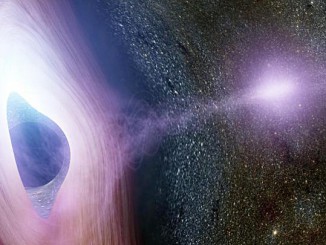
The baffling and strange behaviours of black holes have become somewhat less mysterious recently, with new observations from NASA’s Explorer missions Swift and the Nuclear Spectroscopic Telescope Array, or NuSTAR. The two space telescopes caught a supermassive black hole known as Mrk 335 in the midst of a giant eruption of X-ray light.

News

Cassini ready to dive deep into Saturn moon’s erupting water plume

On Wednesday, 28 October 2015, NASA’s Cassini spacecraft will take the deepest dive ever through the plume of ice, water vapour and organic molecules spraying from the south polar region of Saturn’s moon Enceladus. Scientists hope this close flyby will shed light on what’s happening beneath the moon’s icy surface. With a global ocean and likely hydrothermal activity, could Enceladus have the ingredients needed to support simple forms of life?

News

Halloween asteroid’s close fly-by a treat for radar astronomers

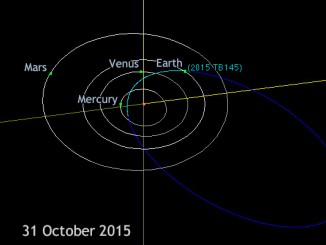
NASA scientists are tracking the upcoming Halloween flyby of asteroid 2015 TB145 with several optical observatories and the radar capabilities of the agency’s Deep Space Network at Goldstone, California. Only discovered sixteen days ago, the 400-metre-wide asteroid will fly past Earth at a safe distance slightly farther than the Moon’s orbit on 31 October at 5:05pm GMT.

Picture This

Kerberos completes family portrait of Pluto’s moons

Images just sent back to Earth this week of Pluto’s tiny moon tiny Kerberos taken by NASA’s New Horizons spacecraft complete the family portrait of Pluto’s moons. Kerberos has a double-lobed shape suggesting that it could have been formed by the merger of two smaller objects. It also appears to be smaller than scientists expected and has a highly-reflective surface, counter to predictions prior to the Pluto flyby in July.