X-Highlight
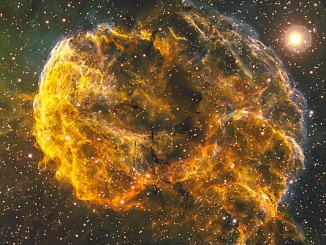
VLT studies mysterious dwarf galaxy born in cosmic collision
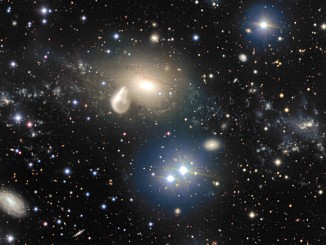
The spectacular aftermath of a 360 million year old cosmic collision is revealed in great detail in new images from ESO’s Very Large Telescope. Among the debris is a rare and mysterious young dwarf galaxy. This galaxy is providing astronomers with an excellent opportunity to learn more about similar galaxies that are expected to be common in the early universe, but are normally too faint and distant to be observed by current telescopes.
Saturn’s moon Prometheus seen up close
NASA’s Cassini spacecraft spied details on the pockmarked surface of Saturn’s moon Prometheus (86 kilometres, or 53 miles across) during a moderately close flyby on 6 December 2015. This is one of Cassini’s highest resolution views of Prometheus, a moon which orbits Saturn just interior to the narrow F ring, which is seen here at top.
Get ready for the Geminid meteor shower!
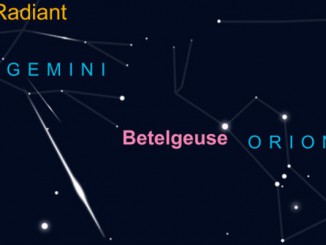
The Geminids of 8—17 December are widely regarded as the most active and consistent annual meteor shower, with peak predicted rates of 100 shooting stars per hour under dark skies. With new Moon occurring on Friday, 11 December, prospects for this year’s Geminid display are therefore expected to be very favourable — UK weather permitting!
ALMA spots monstrous baby galaxies cradled in dark matter
Astronomers using the Atacama Large Millimetre/submillimetre Array (ALMA) have discovered a nest of colossal baby galaxies 11.5 billion light-years away. The young galaxies seem to reside at the junction of gigantic filaments in a web of dark matter. These findings are important for understanding how enormous galaxies like these are formed and how they evolve into huge elliptical galaxies.
Magnified image of the faintest galaxy from the early universe
Astronomers harnessing the combined power of NASA’s Hubble and Spitzer space telescopes have found the faintest object ever seen in the early universe. It existed about 400 million years after the big bang, 13.8 billion years ago. The new object is comparable in size to the Large Magellanic Cloud (LMC), a diminutive satellite galaxy of our Milky Way.