News

Unexpected changes of bright spots on Ceres discovered

New and very precise observations using the HARPS spectrograph with the ESO 3.6-metre telescope in Chile have not only detected the motion of the enigmatic bright spots on Ceres due to the dwarf planet’s rotation about its axis, but also found unexpected additional variations suggesting that the material of the spots is volatile and evaporates in sunlight.

News

How to detect colliding black holes

Shortly to be honoured with a Bessel Award of the Humboldt Foundation, Professor Harald Pfeiffer’s research into solving Einstein’s equations on supercomputers not only helps us locate black holes in the Universe and determine their size, but his calculations also teach us how space-time behaves when it is warped by black holes.

News

Researchers propose a new model for dark matter

Indisputable physical calculations state that approximately 27 percent of the universe is dark matter, but there are indications that we might never see it. Now researchers in Denmark turn this somehow depressing scenario into an advantage and propose a new model for what dark matter might be — and how to test it.

News

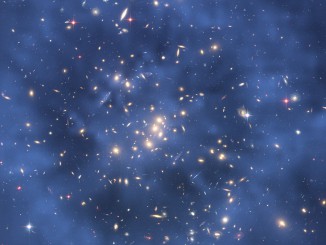
Telescopes combine to push frontier on galaxy clusters

Galaxy clusters are enormous collections of hundreds or even thousands of galaxies and vast reservoirs of hot gas embedded in massive clouds of dark matter. To learn more about clusters, including how they grow via collisions, astronomers have used some of the world’s most powerful X-ray, optical and radio telescopes. The name for this galaxy cluster project is the “Frontier Fields”.

Picture This

The Saturnian sisters

Similar in many ways, Saturn’s moons Tethys and Rhea (left and right, respectively) even share a discoverer: Giovanni Cassini, namesake of the NASA spacecraft that captured this view. Although somewhat different in size, Rhea (949 miles across) and Tethys (660 miles) are both composed largely of ices and are generally thought to be geologically inactive today.