Observing

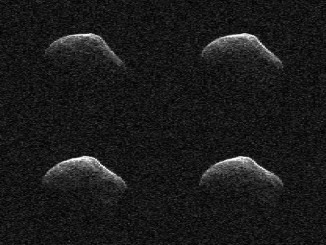
See comet 252P emerge in the UK predawn sky

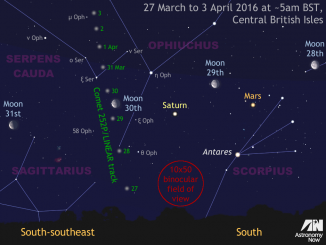
When 252P/LINEAR passed just 14 lunar distances from Earth on 21 March, the comet was galloping across the far southern sky at a rate of almost ten degrees per day. Now rapidly heading north, 252P finally appears in the predawn UK sky. While moonlight will interfere with current observations, the comet is much brighter than predicted.
News

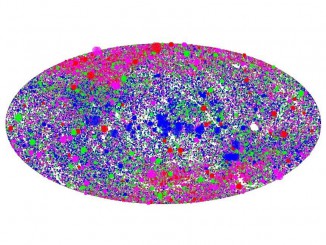
A new view of the X-ray sky

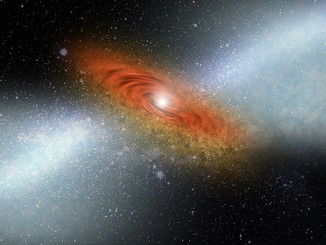
In the 1990s, the ROSAT X-ray satellite performed the first deep all-sky survey. Scientists at the Max Planck Institute for Extraterrestrial Physics (MPE) have revisited the all-sky survey, publishing an extended “2RXS catalogue” — the deepest and cleanest X-ray all-sky survey to date.

News

Moons of Saturn may be younger than the dinosaurs

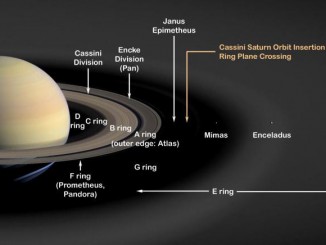
New research suggests that some of Saturn’s icy moons, as well as its famous rings, might be modern adornments. Their dramatic birth may have taken place a mere 100 million years ago. This would date the formation of the major moons of Saturn, with the exception of more distant Titan and Iapetus, to the relatively recent Cretaceous Period — the era of the dinosaurs.

News

Cassini spies Titan’s tallest peaks

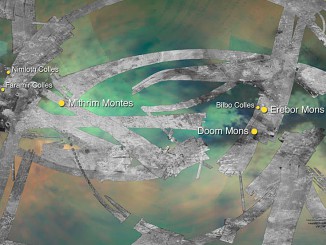
By convention, mountains on Saturn’s largest moon, Titan, are named for mountains from Middle-earth, the fictional setting in fantasy novels by J.R.R. Tolkien. Unfortunately for “Lord of the Rings” fans, Titan’s highest peak is not Doom Mons, but a trio of ridges known as Mithrim Montes, where the tallest peak is 10,948 feet (3,337 metres) high.

News

A new way to determine the age of stars?

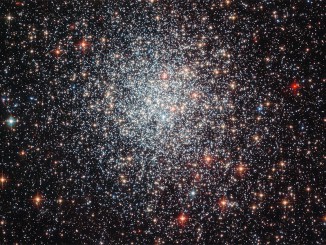
Researchers have developed a new conceptual framework for understanding how stars similar to our Sun evolve. Their framework helps explain how the rotation of stars, their emission of X-rays, and the intensity of their stellar winds vary with time. Their work could ultimately help to determine the age of stars more precisely than is currently possible.

News

Ancient lunar polar ice reveals tilting of Moon’s axis

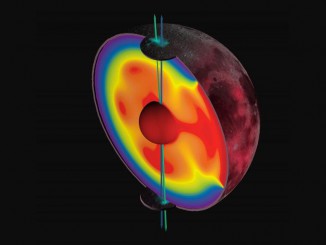
Did the “Man in the Moon” look different from ancient Earth? New NASA-funded research provides evidence that the spin axis of the Moon shifted by about five degrees roughly three billion years ago. The evidence of this motion is recorded in the distribution of ancient lunar ice, evidence of delivery of water to the early solar system.