
X-Highlight
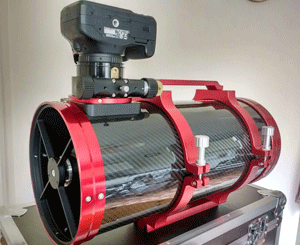
SharpStar D 150mm f/2.8 HNT: An imaging telescope with sharp vision
Until comparatively recently, your best tool for capturing wide-angle vistas of extended deep-sky objects with a full-frame DSLR or CCD/CMOS camera was a fast prime lens from one of the big-name players in photography. Now you can attain these swift imaging speeds with hyperbolic Newtonians, such as the SharpStar 15028HNT.
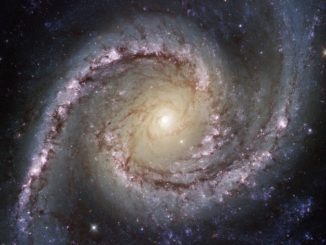
Hubble spies the archetypal barred spiral galaxy
Discovered in 1784 by William Herschel, NGC 4394 is the archetypal barred spiral galaxy, with bright spiral arms emerging from the ends of a bar that cuts through the galaxy’s central bulge. Some 55 million light-years from Earth, the galaxy lies in the constellation of Coma Berenices. NGC 4394 is considered to be a member of the Virgo Cluster.
Rare transit of Mercury to take place on 9 May
On Monday, 9 May there will be a rare transit of Mercury, when the innermost planet in our solar system will pass directly between the Earth and the Sun. The last time this happened was in 2006. With a properly filtered telescope and fine weather, the entire 7½-hour event can be seen from the British Isles.
A piece of the early solar system returns after billions of years in cold storage
Astronomers have found a unique object that appears to be made of material from the time of Earth’s formation, which has been preserved in the Oort Cloud for billions of years. C/2014 S3 (PANSTARRS) is the first object to be discovered on a long-period cometary orbit that has the characteristics of a pristine inner solar system asteroid.
Radioactive ‘timers’ reveal likely source of galactic cosmic rays
Most of the cosmic rays arriving at Earth from our galaxy come from nearby clusters of massive stars, according to new observations from NASA’s Advanced Composition Explorer (ACE) spacecraft. But the detection of a few radioactive cosmic-ray iron nuclei also indicates that there has been a supernova in our galactic neighbourhood within the last few million years.
New Ceres images show bright craters
Craters with bright material on dwarf planet Ceres shine in new images from NASA’s Dawn mission taken from its lowest-altitude mapping orbit. Young crater Haulani (diameter 21 miles) and 6-mile-wide Oxo Crater — the second-brightest feature on Ceres — provide scientists with insight into the dwarf planet’s materials and surface morphology.