26 August 2026
Astronomy Now
  • Home
  • The Magazine
    • About
    • Current Issue
    • Subscribe
    • Renew Subscription
  • AstroFest 2026
  • News
  • Observing
    • UK Sky Chart
    • Almanac
    • Scope Calc
    • DSLR Calc
  • Reviews
    • Equipment
    • Book Reviews
  • Spaceflight Now
  • Shop
  • Contact Us
    • Subscriptions
    • Your Views
    • Ask Astronomy Now
    • Editorial
    • Advertising
    • AstroListings
Latest News
  • [ 24 August 2026 ] JWST’s ‘impossible’ early galaxies may be even more massive than we thought News
  • [ 7 August 2026 ] How to observe the 12 August 2026 solar eclipse Eclipse
  • [ 5 August 2026 ] Falcon 9 lunar impact: More than a new crater News
  • [ 25 July 2026 ] Euclid opens a new window on the first billion years of cosmic history News
  • [ 10 June 2026 ] Caught in the act: the wind that could kill a galaxy News
  • Facebook
  • Twitter
  • LinkedIn

Archive

News

MAVEN spacecraft’s first deep dip into Martian atmosphere

21 February 2015 Astronomy Now

NASA’s MAVEN mission has just completed the first of five deep-dip manoeuvres, lowering its closest approach to Mars to just 125 kilometres (78 miles), which will yield valuable data about the upper atmosphere of the Red Planet.

News

Space telescopes measure speed and shape of ultra-fast quasar winds

20 February 2015 Astronomy Now

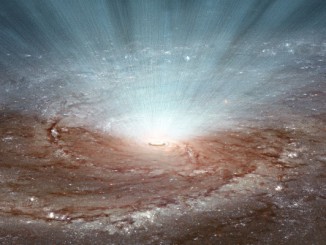
Astronomers using NASA and ESA X-ray space telescopes discover that PDS 456, an extremely bright black hole known as a quasar more than 2 billion light-years away, sustains winds that carry more energy every second than is emitted by more than a trillion suns.

News

New Horizons spots Pluto’s small moons

19 February 2015 Astronomy Now

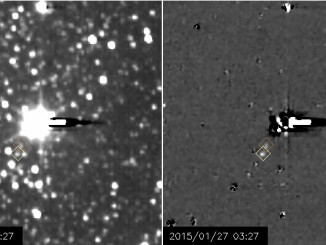
Exactly 85 years after Clyde Tombaugh’s historic discovery of Pluto, NASA’s New Horizons spacecraft set to encounter the icy dwarf planet this summer is providing its first views of the small moons orbiting Pluto.

Picture This

The UK under a curtain of aurora

19 February 2015 Astronomy Now

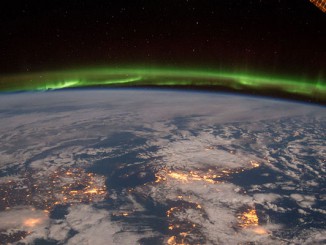
NASA astronaut Terry Virts captured this stunning image of the United Kingdom, Ireland and Scandinavia on a moonlit night beneath an amazing curtain of aurora.

News

Does dark matter cause mass extinctions and geologic upheavals?

19 February 2015 Astronomy Now

Research conducted at New York University suggests that the Solar System’s movement through concentrations of galactic dark matter may perturb the orbits of comets and cause additional heating in the Earth’s core, both of which could be connected with mass extinction events.

News

Sun’s close encounter with Scholz’s Star

18 February 2015 Astronomy Now

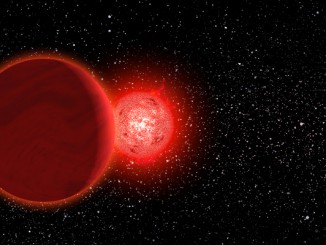
Astronomers using large telescopes in South Africa and Chile identify the closest known flyby of a star to our Solar System: a low-mass star system nicknamed “Scholz’s Star” that passed through the Oort Cloud 70,000 years ago.

News

Dawn captures sharper images of Ceres

17 February 2015 Astronomy Now

Now less than three weeks away from its historic rendezvous with dwarf planet Ceres, the latest images from NASA’s Dawn spacecraft show a myriad of craters and mysterious bright spots on the tiny world.

News

Mystery plumes in Martian atmosphere baffle scientists

17 February 2015 Astronomy Now

Research just published in Nature describes two bright, extremely high-altitude plumes observed on Mars by amateur astronomers in March and April 2012, but attempts at explaining the phenomena defy our current understanding of the Martian upper atmosphere.

News

Photos from Rosetta’s Valentine’s Day comet close-up

17 February 2015 Stephen Clark

Europe’s Rosetta spacecraft — six months into its research mission at comet 67P/Churyumov-Gerasimenko — made its closest flyby of the comet’s boulder-strewn nucleus Saturday, capturing new photos and measurements to help scientists unravel how the duck-shaped body is evolving on its orbit around the sun.

News

ALMA sees super stellar nurseries at heart of starburst galaxy

16 February 2015 Astronomy Now

Starburst galaxies transmute gas into new stars up to 1,000 times faster than typical spiral galaxies like the Milky Way. To try and understand why, an international team of astronomers used the Atacama Large Millimeter/submillimetre Array (ALMA) to dissect a cluster of star-forming clouds at the heart of NGC 253 — one of the nearest starburst galaxies.

Posts pagination

« 1 … 333 334 335 … 357 »

Latest Issue

Astronomy Now Newsletter

Get the wonders of the Universe delivered to your inbox.
* indicates required
Which elements of Astronomy interest you?

News Headlines

  • JWST’s ‘impossible’ early galaxies may be even more massive than we thought
    24 August 2026
  • How to observe the 12 August 2026 solar eclipse
    7 August 2026
  • Falcon 9 lunar impact: More than a new crater
    5 August 2026
  • Euclid opens a new window on the first billion years of cosmic history
    25 July 2026
  • Caught in the act: the wind that could kill a galaxy
    10 June 2026

© 2026 Nebula Press Ltd

Astronomy Now